“With that being said” is a common English expression used to connect ideas, introduce a contrasting point, or move a conversation toward a conclusion. People often use it in professional emails, presentations, essays, meetings, and everyday conversations. It helps speakers acknowledge one point before explaining another, especially when the next statement adds a qualification or presents a different perspective.
For example, you might say, “The project has been challenging. With that being said, we have made excellent progress.” The phrase connects the project’s difficulties with the positive result that follows.With that being said” is a common English expression used to introduce a contrasting idea, add an important point, or transition smoothly from one thought to another.
It helps connect ideas while showing that the speaker is considering a different perspective or moving the conversation forward. For example, someone might say, “The project was challenging. With that being said, we learned a lot from the experience.” This phrase is widely used in everyday conversations, professional emails, presentations, articles, and discussions.
Although “with that being said” is useful, repeating it too often can make your writing or speech sound predictable. Learning other ways to say “with that being said” can help you communicate more clearly, improve your vocabulary, and make your sentences flow naturally. Whether you are writing a business email, participating in a meeting, preparing an essay, or having a casual conversation, choosing the right alternative can help you express your ideas more effectively.
There are many natural alternatives to this expression, including “That said,” “Having said that,” “Nevertheless,” “Even so,” “On the other hand,” and “That being the case.” Each phrase has a slightly different meaning and tone. Some are suitable for formal writing and professional communication, while others work better in casual conversations or friendly discussions. Understanding these differences can help you select the most appropriate expression for your situation.
In this article, we will explore more than 20 other ways to say “with that being said,” along with their meanings, usage tips, and practical example sentences. Whether you are an English learner looking to expand your vocabulary, a professional aiming to improve your writing, or someone who wants to sound more natural in everyday conversations, these alternatives will help you communicate with greater confidence. By learning how to use them correctly, you can avoid repetition, connect your ideas smoothly, and make your communication more engaging and effective.
Although “with that being said” is widely understood, repeating it too often can make your writing sound predictable or unnecessarily wordy. Depending on the situation, alternatives such as “that said,” “however,” “nevertheless,” “even so,” and “having said that” may communicate your meaning more naturally. Some expressions are suitable for formal writing, while others work better in casual conversations or friendly messages.
Learning different ways to say “with that being said” can help you express contrast, introduce a qualification, and organize your thoughts more effectively. It can also make your English sound smoother and more confident, especially when you are writing professional emails, preparing presentations, or participating in discussions.
In this guide, you’ll discover more than 30 alternatives to “with that being said,” including common, formal, professional, casual, polite, and conversational expressions. Each alternative includes a simple definition, guidance on when to use it, a tone label, and practical examples. You’ll also learn how to choose the right phrase for different situations and avoid common mistakes.
What Does “With That Being Said” Mean?
“With that being said” is a transitional expression that connects one statement to another. It often signals that the speaker is about to introduce a contrasting idea, add an important qualification, or shift the discussion in a slightly different direction.
Consider this example:
“The new software is expensive. With that being said, it offers several features that could save us time.”
The first sentence highlights a disadvantage: the software costs a lot. The second sentence acknowledges a benefit that helps balance the discussion.
The expression does not always introduce a direct contradiction. Sometimes it simply moves the conversation forward after acknowledging an earlier point.
For example:
“We have completed the research and gathered feedback from customers. With that being said, we are ready to present our recommendations.”
Here, the phrase signals a transition from completed work to the next step.
The expression is common in spoken English and informal professional communication. However, in formal writing, shorter alternatives such as “however,” “nevertheless,” or “that said” may be clearer.
Why Use Alternatives to “With That Being Said”?
Although the phrase is useful, choosing a different transition can improve clarity and make your communication more natural.
Here are a few reasons to use alternatives:
- To avoid repetition: Using the same transition repeatedly can make an essay, email, or presentation feel repetitive.
- To express contrast more precisely: “However” directly introduces a contrasting point, while “even so” emphasizes that something remains true despite a difficulty.
- To sound more professional: In formal reports, concise transitions often communicate ideas more clearly.
- To make conversations flow naturally: Expressions such as “that said” and “still” can sound less cumbersome in everyday speech.
- To match your audience: A business report may call for “nevertheless,” while a message to a coworker may sound more natural with “that said.”
- To clarify your argument: Choosing the right transition helps readers understand how two ideas relate to each other.
The most important point is that these expressions are not always interchangeable. Some introduce contrast, others add a qualification, and some simply move a discussion forward. Understanding the difference helps you choose the most appropriate phrase.
1. Common Alternatives to “With That Being Said”
These expressions are widely useful because they help connect ideas without making your writing sound overly formal or complicated.
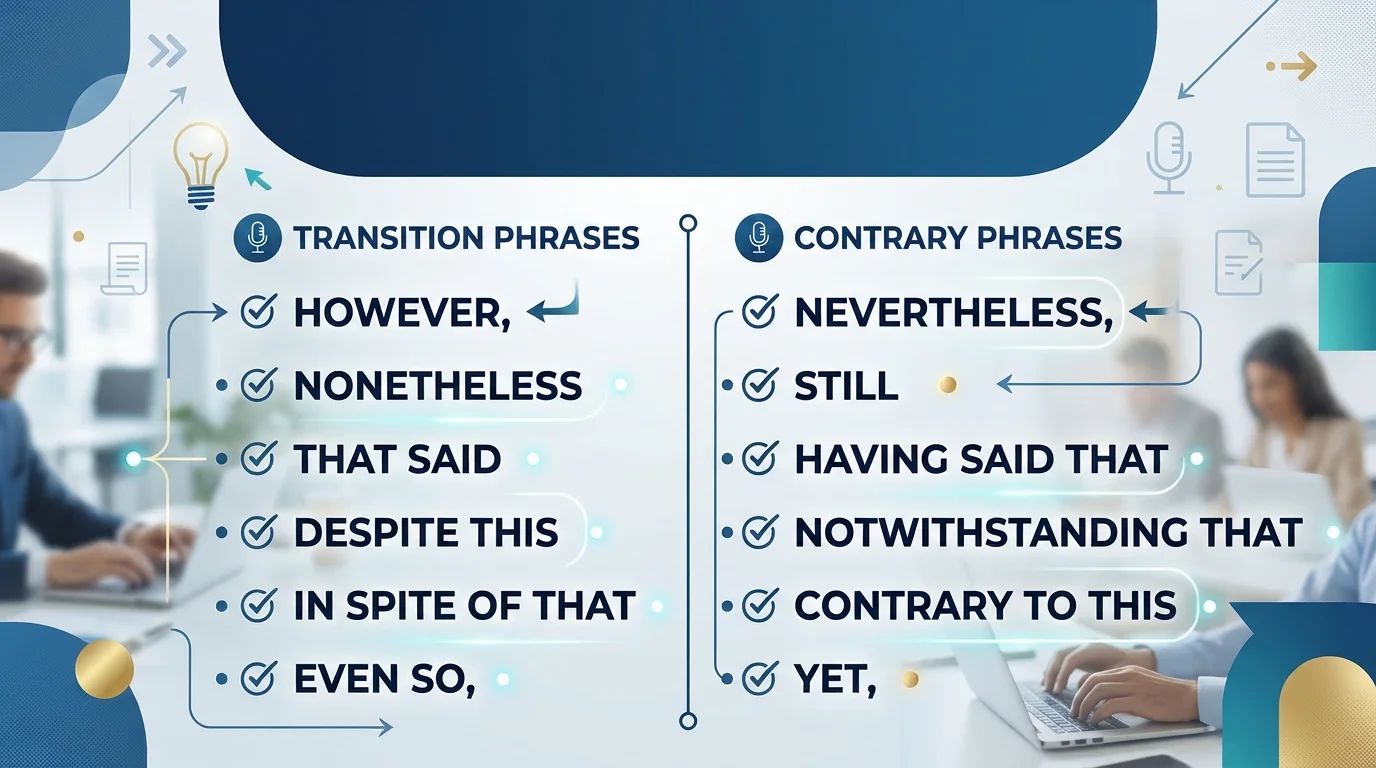
1. That Said
Meaning: “That said” introduces a qualification or contrasting point after acknowledging something previously mentioned.
When to use it: Use it in emails, essays, presentations, meetings, and everyday conversations when you want to recognize one point before adding another.
Tone: Neutral, professional, and conversational.
Examples:
- “The deadline is tight. That said, I believe we can finish the project on time.”
- “The restaurant was expensive. That said, the food was excellent.”
This is one of the closest and most versatile alternatives to “with that being said.” It is shorter, more direct, and usually sounds natural in both spoken and written English.
2. However
Meaning: “However” introduces a statement that contrasts with or qualifies the previous one.
When to use it: Use it in professional emails, academic writing, reports, and everyday discussions when you want to present a contrasting idea.
Tone: Neutral, formal, or professional depending on the context.
Examples:
- “The first proposal is affordable. However, it does not meet all our requirements.”
- “I understand your concerns. However, we still need to make a decision today.”
“However” is a particularly useful choice when you want a clear, direct transition. Unlike “with that being said,” it can be used in many formal contexts without sounding conversational.
3. Having Said That
Meaning: This expression introduces a qualification or a new perspective after acknowledging an earlier statement.
When to use it: Use it in discussions, presentations, meetings, and informal professional writing.
Tone: Conversational, professional, and neutral.
Examples:
- “The training takes several hours. Having said that, it gives employees valuable practical skills.”
- “I haven’t worked with this client before. Having said that, I’m confident we can establish a good relationship.”
This phrase is very close in meaning to “with that being said.” It works well when you want to acknowledge a point before explaining why the situation may be more complicated than it first appears.
4. Even So
Meaning: “Even so” means that something remains true or happens despite the circumstances just mentioned.
When to use it: Use it when the second statement remains valid despite a difficulty, obstacle, or disadvantage.
Tone: Neutral, conversational, and professional.
Examples:
- “The weather was terrible. Even so, the event attracted a large crowd.”
- “We have limited resources. Even so, we can make meaningful progress.”
This expression emphasizes persistence despite a challenge. It is often more precise than “with that being said” when you want to highlight that a difficulty does not change the outcome or conclusion.
5. Still
Meaning: “Still” introduces a point that remains true despite something that might suggest otherwise.
When to use it: Use it in everyday conversations, informal emails, and professional discussions when you want a short transition.
Tone: Casual, neutral, and conversational.
Examples:
- “The instructions are complicated. Still, I think we can figure them out.”
- “The apartment is small. Still, it has everything I need.”
“Still” is concise and natural. It is particularly useful when you want to keep your sentence simple rather than use a longer transitional phrase.
6. Nevertheless
Meaning: “Nevertheless” means that something remains true despite a previous fact, problem, or objection.
When to use it: Use it in formal writing, professional reports, academic essays, and serious discussions.
Tone: Formal and professional.
Examples:
- “The initial results were disappointing. Nevertheless, the team continued its research.”
- “The proposal has several limitations. Nevertheless, it offers a promising starting point.”
“Nevertheless” often sounds more formal than “even so” or “still.” It is a strong option when you want to emphasize that a conclusion holds despite an obstacle.
2. Formal Alternatives to “With That Being Said”
Formal transitions can make essays, reports, business proposals, and official correspondence more concise and organized. These expressions are especially useful when you need to communicate a contrast clearly.
7. Nonetheless
Meaning: “Nonetheless” means “despite that” or “in spite of what was just mentioned.”
When to use it: Use it in formal writing, business reports, academic discussions, and professional presentations.
Tone: Formal and professional.
Examples:
- “The results were not conclusive. Nonetheless, the research provided useful insights.”
- “The project faced several delays. Nonetheless, we delivered the final product.”
“Nonetheless” is similar to “nevertheless.” Both emphasize that a point remains valid despite a previous concern. The difference is subtle, and either may work in many of the same contexts.
8. Notwithstanding That
Meaning: This expression means “despite that” or “even though that is the case.”
When to use it: Use it sparingly in formal writing when you need to acknowledge a fact without allowing it to determine the entire conclusion.
Tone: Very formal.
Examples:
- “The proposal requires additional funding. Notwithstanding that, the expected benefits may justify the investment.”
- “The process is time-consuming. Notwithstanding that concern, it may still be the most reliable option.”
This phrase can sound legalistic or stiff. In most modern business writing, “despite that,” “even so,” or “nevertheless” is simpler and easier to read.
9. Despite This
Meaning: “Despite this” means that something happens or remains true even though the previously mentioned situation might make it seem unlikely.
When to use it: Use it in formal emails, reports, academic writing, and explanatory discussions.
Tone: Formal, neutral, and professional.
Examples:
- “The initial budget was reduced. Despite this, the team completed the project successfully.”
- “The process presented several challenges. Despite this, the final results met our expectations.”
This phrase works well when the second statement describes an outcome that occurred in spite of a specific difficulty.
10. In Spite of That
Meaning: This expression introduces an outcome or fact that remains true despite a previous obstacle or disadvantage.
When to use it: Use it in both professional and everyday writing when you want to emphasize persistence or an unexpected outcome.
Tone: Neutral, polite, and conversational.
Examples:
- “We had very little time to prepare. In spite of that, the presentation went well.”
- “The course was challenging. In spite of that, I learned a great deal.”
“In spite of that” and “despite this” have very similar meanings. Choose whichever fits your sentence more naturally.
11. Be That as It May
Meaning: This expression acknowledges a previous statement while indicating that it does not change the point you are about to make.
When to use it: Use it in formal discussions, persuasive writing, or situations where you want to move past an objection.
Tone: Formal and somewhat traditional.
Examples:
- “The original plan was ambitious. Be that as it may, we still need to determine whether it is practical.”
- “There are valid concerns about the cost. Be that as it may, the decision must be based on the project’s overall value.”
This expression can sound old-fashioned or overly formal in everyday conversation. In most situations, “that said” or “even so” will sound more natural.
3. Professional Alternatives for Emails and Meetings
Professional communication benefits from transitions that clearly show how your ideas connect. The following alternatives work well in meetings, workplace emails, presentations, and discussions with clients.
12. On the Other Hand
Meaning: This expression introduces a different perspective, consideration, or side of an issue.
When to use it: Use it when comparing two options or presenting an alternative viewpoint.
Tone: Neutral, professional, and conversational.
Examples:
- “The first option is less expensive. On the other hand, the second option offers better long-term support.”
- “Working remotely saves commuting time. On the other hand, some employees prefer face-to-face collaboration.”
Unlike “with that being said,” “on the other hand” often works best when you are comparing two distinct sides of an issue. It is especially useful for balanced discussions and decision-making.
13. At the Same Time
Meaning: This phrase acknowledges another consideration that exists alongside the first one.
When to use it: Use it when two facts, concerns, or responsibilities must be considered together.
Tone: Professional, neutral, and conversational.
Examples:
- “We need to reduce expenses. At the same time, we must maintain the quality of our service.”
- “I understand the need for speed. At the same time, we cannot overlook important details.”
This expression does not always signal direct opposition. It often highlights that two considerations are important at once.
14. With That in Mind
Meaning: This phrase introduces a conclusion, decision, or recommendation based on information already discussed.
When to use it: Use it in professional emails, meetings, presentations, and planning discussions.
Tone: Professional, thoughtful, and neutral.
Examples:
- “The client prefers a simpler design. With that in mind, we’ll prepare a more streamlined version.”
- “Our budget is limited. With that in mind, I recommend focusing on the most important features first.”
This is a useful alternative when you want to explain what you will do after considering the facts. It is more about applying earlier information than directly contrasting two ideas.
15. Given That
Meaning: “Given that” introduces a fact or circumstance that helps explain the reasoning behind a conclusion.
When to use it: Use it when the next point follows logically from the information you have just mentioned.
Tone: Professional, neutral, and formal.
Examples:
- “Given that the deadline is approaching, we should finalize the schedule today.”
- “Given that several team members are unavailable, we may need to postpone the meeting.”
This expression is not an exact synonym for “with that being said.” It introduces a reason or relevant circumstance rather than a contrasting point. Use it when you want to show why your next statement makes sense.
16. Taking That Into Account
Meaning: This phrase means that you are considering the information already discussed before making a decision or recommendation.
When to use it: Use it in project planning, professional emails, reports, and discussions about practical decisions.
Tone: Professional and thoughtful.
Examples:
- “Taking that into account, I suggest extending the deadline by two days.”
- “The customer has requested additional features. Taking that into account, we should revise the original estimate.”
This expression is especially useful when moving from an explanation to a decision. It makes the connection between the available information and your recommendation clear.
17. All Things Considered
Meaning: This phrase introduces a judgment or conclusion reached after thinking about the different factors involved.
When to use it: Use it when summarizing a decision, evaluating options, or reaching a balanced conclusion.
Tone: Neutral, professional, and conversational.
Examples:
- “All things considered, the second proposal offers the best value.”
- “All things considered, the event was a success despite the unexpected delays.”
This expression usually summarizes an overall evaluation rather than introducing a simple contrast. It is a good choice when you have weighed several advantages and disadvantages.
4. Casual and Conversational Alternatives
In everyday conversations, you can often replace “with that being said” with a shorter expression. These alternatives sound natural when talking to friends, family members, and familiar coworkers.
18. Anyway
Meaning: “Anyway” can signal a return to the main point, a change of subject, or a move forward after discussing something else.
When to use it: Use it in casual conversations when you want to move the discussion along.
Tone: Casual and conversational.
Examples:
- “The restaurant was crowded. Anyway, we managed to find a table.”
- “I still have a few things to finish. Anyway, let’s talk about the weekend.”
“Anyway” is not always a direct substitute for “with that being said.” It often signals a shift in conversation rather than a logical contrast. In formal writing, choose a more precise transition.
19. Still, Though
Meaning: This conversational combination introduces a point that remains true despite what was just mentioned.
When to use it: Use it in casual conversations, informal messages, and relaxed workplace discussions.
Tone: Casual and friendly.
Examples:
- “The movie was a little long. Still, though, I enjoyed it.”
- “The trip was tiring. Still, though, I’m glad we went.”
This combination can sound natural in speech, although “still” or “though” alone is often enough. Avoid combining them unnecessarily in formal writing.
FAQs
1. What is the best alternative to “with that being said”?
“That said” is one of the closest alternatives. It is shorter and works in professional emails, presentations, and everyday conversations. “However” is also a strong choice when you want to introduce a clear contrast.
2. Is “with that being said” grammatically correct?
Yes. It is a widely understood transitional expression. However, it can sometimes be wordy. In many situations, “that said,” “however,” or “even so” communicates the same idea more concisely.
3. Is “that said” more professional than “with that being said”?
Both expressions can be professional. “That said” is shorter and often sounds more direct. “With that being said” is also acceptable, especially in conversation, but concise wording is often preferable in formal writing.
4. Can I use “however” instead of “with that being said”?
Yes, when you want to introduce a contrasting or qualifying idea. For example, “The plan is affordable. However, it may take longer to implement.” If you are moving from information to a recommendation, “with that in mind” may be more appropriate.
5. What is a casual way to say “with that being said”?
“That said,” “still,” “even so,” and “anyway” can work in casual conversations. The best choice depends on your meaning. “Anyway” often changes the direction of a conversation, while “even so” emphasizes that something remains true despite a difficulty.
6. What is the difference between “with that being said” and “with that in mind”?
“With that being said” often introduces a qualification or contrast. “With that in mind” usually introduces a decision, recommendation, or next step based on information already discussed.
For example: “The budget is limited. With that in mind, we should focus on the essential features first.”
7. Should I use “with that being said” in academic writing?
You can, but “however,” “nevertheless,” “nonetheless,” and “despite this” may be more concise and precise. Choose the transition that accurately expresses the relationship between your ideas, and follow the style guidelines required by your school or institution.
Conclusion
There are many effective ways to say “with that being said,” and choosing the right alternative can make your communication clearer, more natural, and more engaging.
For everyday and professional situations, “that said” is a versatile choice. Use “however” when you want to introduce a contrast, “even so” when a point remains true despite a difficulty, and “nevertheless” or “nonetheless” when a more formal tone is appropriate. If you are moving from information to a recommendation, “with that in mind” or “in light of this” may express your meaning more accurately.
For casual conversations, shorter expressions such as “still” and “anyway” can help your speech flow naturally. For essays, reports, and presentations, choose transitions that make the relationship between your ideas easy to understand.
Remember that these phrases do not all mean exactly the same thing. Some introduce contrast, others explain a reason, and some help you summarize a discussion. Instead of replacing “with that being said” with another expression automatically, think about what you want the next sentence to accomplish.
The best transition is the one that fits your meaning, your audience, and your situation. With practice, you can use these alternatives confidently and make your English sound smoother and more precise.