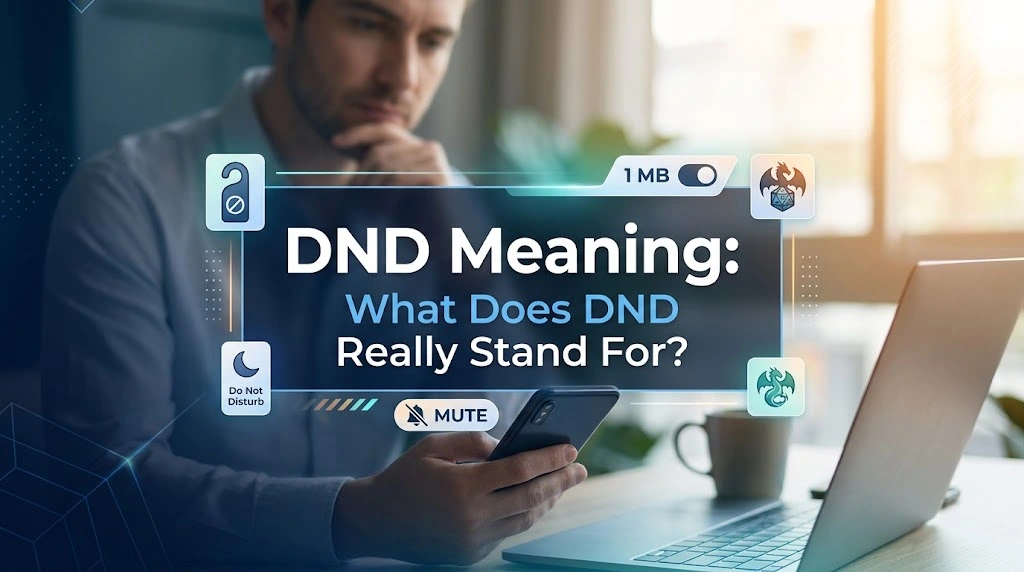
Have you ever received a message that says DND and wondered what it means? The DND meaning usually depends on the context, but in texting and online communication, DND commonly means “Do Not Disturb.” People use this text abbreviation when they don’t want to receive calls, messages, notifications, or interruptions for a certain period. You may see DND in text messages, chat apps, social media, online conversations, and even as a phone status.
When someone says they are DND, they’re generally asking others to give them privacy, space, or quiet time. For example, a person might text, “I’m DND right now. I’ll call you later.” In this case, the abbreviation communicates that the person doesn’t want to be disturbed. The term is especially common in digital communication, where short forms and internet slang help people communicate quickly.
The DND abbreviation can also refer to Do Not Disturb mode, a feature available on smartphones, iPhones, Android devices, messaging apps, and other digital devices. This setting can silence incoming calls, notifications, alerts, and other interruptions. However, DND can have other meanings in different situations, including Dungeons & Dragons, a popular role-playing game.
Quick Answer
DND Meaning usually stands for Do Not Disturb in American digital communication. It signals that someone wants fewer notifications or interruptions, while in gaming culture, DND commonly means Dungeons & Dragons.
TL;DR
- DND most commonly means Do Not Disturb on digital devices.
- It can also mean Dungeons & Dragons in gaming communities.
- Do Not Disturb symbolizes privacy, quiet, focus, and personal boundaries.
- Dungeons & Dragons symbolizes imagination, storytelling, friendship, and adventure.
- American technology helped make DND a familiar everyday abbreviation.
- Context usually reveals which meaning someone intends.
What Does DND Mean?
DND is an abbreviation with two major modern meanings in the United States. The first is Do Not Disturb, a setting that limits alerts, calls, or notifications.
The second is Dungeons & Dragons, a tabletop role-playing game first published in the 1970s. Its abbreviation is often written as D&D, although people sometimes write DND in casual digital communication.
DND as “Do Not Disturb”
When DND means Do Not Disturb, it usually communicates a request for reduced interruption.
You may see it on a smartphone, smartwatch, computer, messaging app, or status message. The exact features vary, but the basic idea remains similar.
- Notifications may be silenced or limited.
- Certain calls may still be allowed.
- Messages can remain visible without immediate alerts.
- The setting can communicate temporary unavailability.
DND as “Dungeons & Dragons”
In gaming, DND refers to a fantasy role-playing game built around shared storytelling.
Players create characters and make choices within a fictional world. A Dungeon Master guides the story, describes situations, and manages the game’s rules.
Because the two meanings are unrelated, surrounding words usually provide the answer.
How DND Appears in Everyday Life
The visual form of DND depends heavily on its meaning. Digital DND often appears through a moon, crossed-out bell, muted speaker, or similar quiet symbol.
These images communicate an idea without requiring words. A person can understand “please don’t interrupt” simply by seeing a status icon.
Common Digital DND Symbols
Technology companies use different designs for their DND features. Still, several visual ideas appear repeatedly.
- A crescent moon often represents nighttime quiet.
- A muted bell suggests suppressed notifications.
- A crossed-out sound icon suggests silence.
- A status label can show temporary unavailability.
The symbols aren’t universal, though. Their exact appearance depends on the device or platform.
DND in Texting
In American texting culture, DND can work as a short status message.
Someone might use it to explain that they aren’t checking messages. The phrase can therefore become a small social boundary.
For example, “DND until 5” usually means the person doesn’t want interruptions until that time.
Historical Roots of “Do Not Disturb”
The idea behind Do Not Disturb is much older than smartphones. People have used signs and signals to indicate privacy for centuries.
A closed door is one of the simplest examples. Before digital technology, a closed door could communicate that someone was sleeping, working, studying, or otherwise unavailable.
From Physical Signs to Digital Status
Hotels and workplaces later made “Do Not Disturb” especially familiar.
A hotel guest could hang a Do Not Disturb sign on a door. The sign gave staff a clear request to avoid entering the room.
Digital technology eventually transformed the same social idea into a device setting.
Instead of placing a sign outside a room, users could place a quiet status around their digital activity.
The Meaning Stayed Surprisingly Similar
The technology changed, but the basic message remained stable.
The DND concept still says, in effect, “Please give me some uninterrupted time.”
That continuity helps explain why the phrase feels natural in modern American technology.
What Does DND Symbolize in America?
In the United States, DND commonly symbolizes privacy, personal space, focus, and control over communication.
Americans increasingly interact through phones and online platforms. As a result, controlling when those devices demand attention has become part of everyday life.
Privacy and Personal Boundaries
DND can represent a person’s decision to create a temporary boundary.
It doesn’t necessarily mean someone is angry or avoiding others. Instead, it can simply communicate that they need uninterrupted time.
This distinction matters because digital silence can easily be misunderstood.
Focus and Productivity
DND also carries strong associations with concentration.
A student might activate it while studying. Someone working on a project might use it during a period requiring sustained attention.
- Studying without constant alerts
- Working through a demanding task
- Reading without interruptions
- Taking a temporary break from notifications
- Sleeping without unnecessary disturbances
A Modern Form of Personal Space
A DND setting can function like a digital “closed door.”
However, it gives users more control. They can often decide which contacts or alerts still come through.
| Context | Meaning in the USA | Common Association | Typical Signal |
| Smartphone | Reduced interruptions | Privacy and focus | Moon or muted icon |
| Workplace | Temporary unavailability | Concentration | Status message |
| Messaging | Delayed response | Personal boundaries | DND status |
| Sleep | Fewer nighttime alerts | Rest and quiet | Nighttime mode |
| Social media | Limited interaction | Digital break | Short status |
The Symbolism of Silence and Quiet
DND has a deeper symbolic meaning because silence itself carries cultural associations.
Quiet can suggest peace, concentration, privacy, rest, or withdrawal. The meaning depends on the situation.
Silence as Peace
In many everyday American settings, silence means relief from constant stimulation.
A person surrounded by notifications may use DND to create a quieter environment. The setting therefore becomes associated with calm.
Silence as a Boundary
Silence can also communicate a boundary.
A DND status doesn’t necessarily reject other people. Instead, it can say that communication should happen later.
This makes the symbol different from an explicit refusal.
Silence as Control
Modern devices constantly compete for attention. DND reverses that relationship.
Rather than allowing every alert to demand an immediate response, the user decides when interruptions are acceptable.
That gives DND a strong association with personal control.
Emotional and Psychological Associations of DND
DND doesn’t have one universal emotional meaning. Still, people often connect it with certain moods and experiences.
For many users, it represents relief. Turning off notifications can reduce the feeling that every sound requires an immediate response.
Common Emotional Associations
DND may suggest:
- Calm after a busy period
- Need for uninterrupted concentration
- Desire for privacy
- Temporary social withdrawal
- Rest and recovery
- Control over digital attention
These associations don’t automatically reveal someone’s feelings.
For example, a DND status doesn’t prove that someone is upset. They may simply be studying, sleeping, or working.
Why the Symbol Feels Powerful
The DND idea addresses a modern problem: constant accessibility.
People can receive messages at almost any hour. Consequently, a simple quiet setting can feel like a meaningful personal boundary.
The symbol therefore represents more than silence. It can represent the right to choose when to respond.
DND in Phones, Social Media, and Modern Technology
DND became especially recognizable through smartphones.
Modern devices can manage notifications according to schedules, locations, activities, or user-selected rules. This has expanded the original meaning of the phrase.
DND and Digital Wellness
People often use quiet settings to create breaks from constant notifications.
This can be especially useful during activities where attention matters. Examples include schoolwork, family conversations, travel, reading, and sleep.
The broader cultural message is simple: being connected doesn’t always require being immediately available.
DND Status Messages
On some platforms, users can display a status indicating that notifications are muted.
This creates a social layer around the technical feature. Other people may understand that a delayed response isn’t necessarily personal.
As a result, DND has become both a device setting and a communication signal.
DND Meaning in Tattoos and Personal Symbolism
DND isn’t one of the most traditional tattoo symbols. However, people can give abbreviations personal meanings through tattoos and other forms of self-expression.
A DND-related design might represent privacy, independence, boundaries, rest, or a desire to protect personal time.
Possible Personal Interpretations
Someone could use DND symbolism to express:
- A commitment to protecting personal boundaries
- The value of quiet and solitude
- A reminder to disconnect from technology
- A preference for focused living
- A meaningful period of personal change
These interpretations are personal rather than universal.
A tattoo involving DND could also refer to Dungeons & Dragons instead. Fantasy imagery, dice, dragons, character symbols, or gaming references can make that meaning clearer.
DND and Dungeons & Dragons
The second major meaning of DND belongs to an entirely different cultural world.
Dungeons & Dragons emerged in the United States during the 1970s. It developed from tabletop gaming traditions, including fantasy role-playing and miniature-based games.
The game lets participants build stories together through characters, rules, chance, and imagination.
What Dungeons & Dragons Symbolizes
In American popular culture, D&D can represent creativity and shared storytelling.
It also became associated with fantasy fandom and tabletop gaming. Over time, those associations expanded into mainstream entertainment.
Common themes include:
- Imagination and creative storytelling
- Friendship through shared play
- Adventure and exploration
- Character growth and personal choice
- Fantasy worlds and mythical creatures
From Niche Hobby to Mainstream Culture
Dungeons & Dragons was once strongly associated with a smaller tabletop gaming community.
Today, however, fantasy role-playing has a much broader cultural presence. Books, streaming shows, podcasts, video games, conventions, and online communities have helped introduce the concept to wider audiences.
The abbreviation DND can therefore carry a distinctly different meaning from digital Do Not Disturb.
Cross-Cultural and Spiritual Associations
The Do Not Disturb concept doesn’t belong to one religion or spiritual tradition.
However, quiet, solitude, and intentional withdrawal appear in many cultures and spiritual practices. Their meanings vary greatly, so they shouldn’t be treated as identical to modern DND.
Quiet in Spiritual Traditions
Many traditions have practices involving silence, contemplation, retreat, or focused attention.
These practices can emphasize reflection or connection with a religious tradition. Digital DND, by contrast, is usually a practical technology feature.
The similarity is mainly conceptual: both can create space away from ordinary distractions.
The Broader Symbol of the Quiet Space
Across cultures, protected quiet spaces can represent reflection and restoration.
A private room, retreat, garden, temple, or meditation area may serve this purpose. Modern DND brings a related idea into digital life.
Still, the symbolism should not be treated as proof of a shared religious meaning.
DND in American Pop Culture
American entertainment has helped spread both major meanings of DND.
Do Not Disturb appears naturally in stories involving hotels, workplaces, phones, and social situations. Dungeons & Dragons appears through fantasy storytelling and gaming culture.
Fantasy and DND
Dungeons & Dragons has become especially visible through popular fantasy media.
Characters, dice, monsters, magic, quests, and imaginary worlds can all signal the gaming meaning. Therefore, visual context often makes the intended meaning obvious.
Digital DND in Popular Culture
The other meaning fits modern stories about phones and online communication.
A character switching to DND can symbolize an attempt to concentrate or escape constant communication. The device setting can therefore become a small storytelling detail with a larger meaning.
Misunderstandings and Misuse of DND
Because DND has multiple meanings, confusion is common.
A person unfamiliar with gaming may read DND as Do Not Disturb. A gamer may immediately think of Dungeons & Dragons instead.
Context Usually Solves the Problem
The surrounding words provide the strongest clue.
“Turn on DND” probably refers to a device setting. “Our DND campaign starts tonight” almost certainly refers to Dungeons & Dragons.
DND Doesn’t Always Mean Rejection
A common social misunderstanding involves interpreting DND as avoidance.
Someone using Do Not Disturb may still care about incoming messages. They may simply want to answer later.
Therefore, the abbreviation shouldn’t automatically be treated as a statement about a relationship or someone’s feelings.
How DND Meaning Has Changed Over Time
The meaning of DND has evolved alongside American technology and entertainment.
The original “Do Not Disturb” idea existed as a physical social signal. Digital devices transformed it into an automated setting.
At the same time, Dungeons & Dragons created a completely separate meaning for the same letters.
A Shift From Physical to Digital
Older generations may associate Do Not Disturb with hotel doors and physical signs.
Younger users may associate it primarily with smartphones and notification controls. Both meanings express a similar desire for uninterrupted time.
A Shift in Gaming Culture
Dungeons & Dragons also changed cultural position over the decades.
It moved from a specialized tabletop hobby into a widely recognized part of American popular culture. That expansion made D&D terminology more familiar outside dedicated gaming groups.
How to Tell Which DND Meaning Someone Means
Context is the easiest way to interpret the abbreviation.
Look at the words surrounding DND rather than assuming one definition automatically applies.
Signs It Means “Do Not Disturb”
You can usually identify the digital meaning when you see words related to phones or communication.
- Phone settings
- Notifications
- Messages
- Calls
- Sleep
- Focus
- Availability
Signs It Means “Dungeons & Dragons”
Gaming vocabulary points toward the fantasy meaning.
- Dungeon Master
- Dice
- Character
- Campaign
- Dungeon
- Fantasy
- Party
- Quest
The punctuation can also help. D&D more directly identifies Dungeons & Dragons, while DND often appears as the abbreviation for Do Not Disturb.
Why DND Still Matters Today
DND reflects two important parts of modern American culture.
One meaning deals with managing digital attention. The other deals with creating imaginary worlds and sharing stories with other people.
Both meanings involve boundaries of a sort. Do Not Disturb creates a boundary around attention, while Dungeons & Dragons creates a boundary around a shared fictional world.
That contrast makes DND an interesting example of how language develops through technology and culture.
A Small Abbreviation With Multiple Identities
Three letters can communicate very different ideas.
In one context, DND means quiet and limited access. In another, it suggests fantasy, adventure, creativity, and community.
The meaning isn’t hidden inside the letters themselves. It comes from the setting in which people use them.
Conclusion
The DND meaning most commonly refers to “Do Not Disturb” in texting, messaging, and everyday digital communication. People use it to indicate that they want quiet, privacy, or a temporary break from calls, texts, and notifications. On phones and other devices, DND mode can also help reduce interruptions by controlling alerts and notifications.However, DND doesn’t always mean Do Not Disturb. In gaming and entertainment contexts, it can refer to Dungeons & Dragons. That’s why context matters when interpreting this abbreviation.
Read More: Understanding “The Latter”: Meaning, Definition, and Examples in English
FAQs
What does DND mean in texting?
In texting, DND usually means “Do Not Disturb.” It tells someone that the person doesn’t want to be interrupted or contacted at that moment.
What does DND mean on a phone?
On a phone, DND usually stands for Do Not Disturb. It’s a feature that can silence or limit calls, notifications, alerts, and other interruptions.
Does DND mean ignore me?
Not necessarily. DND generally means that someone wants to avoid interruptions temporarily. It doesn’t automatically mean they want to ignore you or end the conversation.
What does DND mean on social media?
On social media, DND commonly means Do Not Disturb. Someone may use it to indicate that they don’t want messages, calls, or other interruptions.
Can DND have another meaning?
Yes. DND can also stand for Dungeons & Dragons, especially when people are discussing tabletop gaming, characters, campaigns, or role-playing.
Is DND rude in texting?
Not usually. The tone depends on the situation and how the person uses it. A simple “DND right now” can be a polite way to communicate that they need some uninterrupted time.