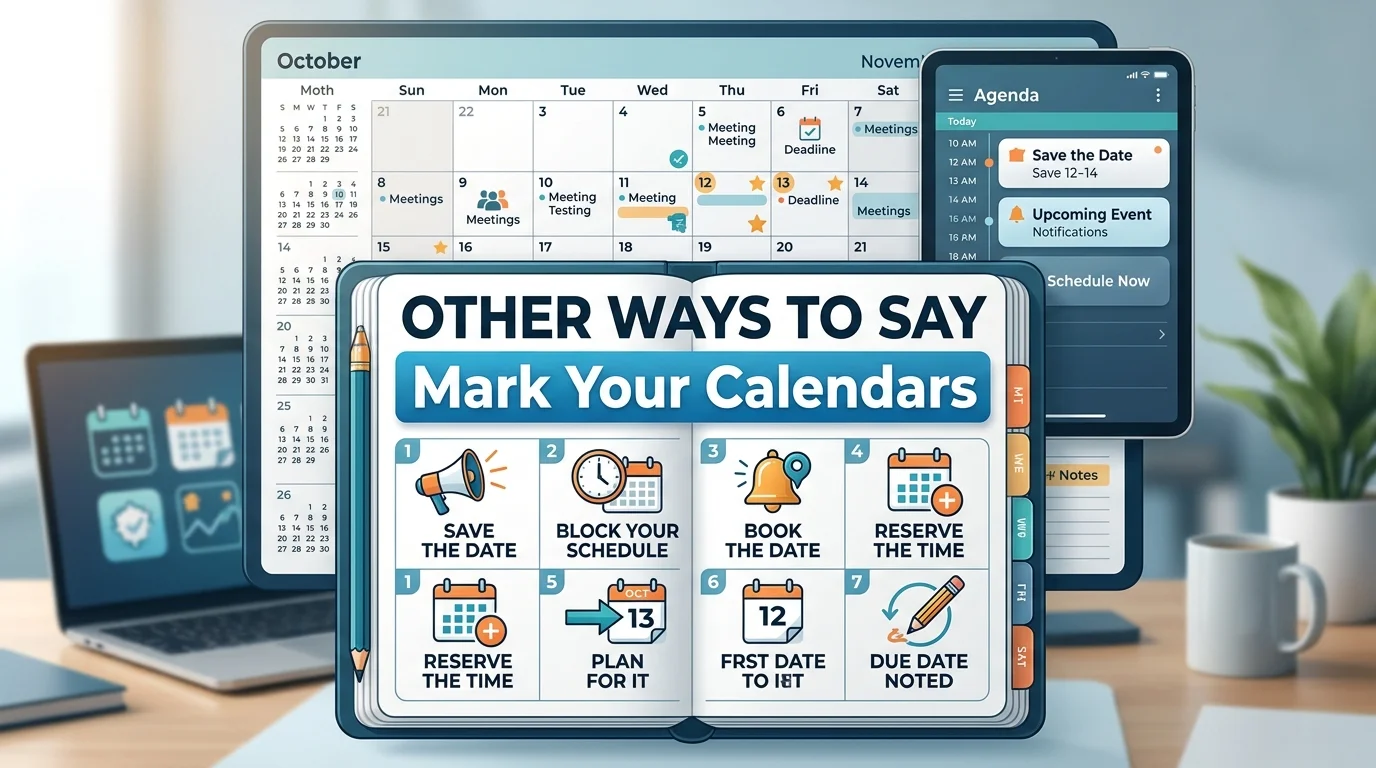
“Mark your calendars” is a common English expression used to remind people about an upcoming event, important date, meeting, celebration, or special occasion. When someone says, “Mark your calendars,” they want you to remember a particular date and make time for it. You might hear this phrase in a workplace announcement, an invitation to a wedding, a social media post, or a message about an upcoming event.
Mark Your Calendars” is a popular English expression used to remind people to remember an important date or upcoming event. It is commonly used for meetings, parties, conferences, special occasions, deadlines, and other activities that people should plan for in advance. Whether you are inviting friends to a celebration, announcing a workplace meeting, or promoting an upcoming event, this phrase helps emphasize that the date is important and should not be forgotten.
However, repeating the same expression can sometimes make your communication sound less interesting. Learning other ways to say “Mark Your Calendars” can help you express yourself more naturally, professionally, and creatively. For example, you might say “Save the Date” when announcing a special occasion, “Make a Note of the Date” when giving a friendly reminder, or “Be Sure to Keep This Date Free” when encouraging someone to set aside time for an event.
The best alternative depends on your audience and the situation. In professional emails, a phrase such as “Please Save the Date” may sound polite and appropriate. In casual conversations with friends, “Don’t Forget This Date” or “Keep This Day Open” may feel more natural. For exciting announcements, expressions like “Circle the Date” or “Get Ready for the Big Day” can create enthusiasm and encourage people to participate.
In this article, we will explore more than 20 natural alternatives to “Mark Your Calendars,” including formal, professional, casual, friendly, and polite expressions. Each alternative will include a simple explanation, guidance on when to use it, and practical examples to help you understand how it works in everyday American English. By learning these expressions, you can make your invitations, announcements, reminders, and conversations clearer, more engaging, and better suited to different situations.
Although “mark your calendars” is friendly and widely understood, it is not always the best choice for every situation. For example, a business announcement may call for a more professional expression, while a text to friends might sound more natural with something casual like “Save the date!” or “Don’t forget!”
Learning different ways to say “mark your calendars” helps you communicate more naturally and choose words that match your audience. Some alternatives sound formal and professional, while others are warm, exciting, or conversational. The right expression can make an announcement clearer, encourage people to attend an event, or remind them about an important deadline without sounding repetitive.
In this guide, you will discover more than 25 natural alternatives to “mark your calendars,” along with their meanings, appropriate uses, tones, and practical examples. Whether you are writing a business email, planning a party, promoting an event, or sending a quick reminder, you will find expressions that fit your needs.
What Does “Mark Your Calendars” Mean?
The phrase “mark your calendars” means to record or remember a particular date so you do not forget an upcoming event or commitment.
Traditionally, people marked dates on paper calendars by circling them, highlighting them, or writing a note beside them. Today, the expression also applies to digital calendars, scheduling apps, and phone reminders.
For example:
“Mark your calendars for November 15 because our annual holiday party is coming up!”
This sentence tells people to remember November 15 and prepare to attend the party.
The expression can serve several purposes:
- Announcing an event: Letting people know about a conference, celebration, or launch.
- Reminding an audience: Encouraging people to remember an important date.
- Building excitement: Creating anticipation for something special.
- Encouraging attendance: Asking people to reserve time for an event.
- Communicating deadlines: Reminding employees or students about an approaching due date.
The phrase is usually friendly and informal, but it can also appear in professional announcements. Its suitability depends on the audience and the context.
1. Common Alternatives to “Mark Your Calendars”
These expressions work in many everyday and professional situations. They are familiar, natural, and easy for English learners to use.
1. Save the Date
Meaning: Remember a particular date and keep it available for an upcoming event.
When to use it: Use this expression for weddings, parties, conferences, reunions, launches, and other planned occasions. It is especially common when an event is announced before all the details are available.
Tone: Friendly, polite, professional, or celebratory.
Examples:
- “Save the date for our annual company picnic on June 12!”
- “We’re getting married next spring! Save the date for May 22.”
Why it works: “Save the date” is one of the closest alternatives to “mark your calendars.” It emphasizes reserving time for an occasion rather than simply remembering it.
2. Don’t Forget the Date
Meaning: Remember the date of an important event or activity.
When to use it: This expression works well in everyday conversation, family messages, classroom announcements, and informal reminders.
Tone: Casual, friendly, and direct.
Examples:
- “Don’t forget the date of our school reunion: August 10.”
- “Don’t forget the date! Your appointment is next Wednesday.”
Why it works: It is straightforward and easy to understand. However, depending on your tone, it can sound slightly commanding. A friendly explanation usually makes it warmer.
3. Keep This Date in Mind
Meaning: Remember a particular date because it may be important later.
When to use it: Use it when you are announcing an upcoming event, giving an early reminder, or sharing information that people may need to plan around.
Tone: Neutral, polite, and professional.
Examples:
- “Keep this date in mind: our next team meeting is scheduled for October 20.”
- “Please keep December 5 in mind for our annual fundraiser.”
Why it works: This expression is less forceful than “don’t forget.” It is useful when you want people to remember a date without immediately asking them to make a formal commitment.
4. Put It on Your Calendar
Meaning: Record an event or appointment in a calendar so you remember it.
When to use it: Use this phrase for meetings, deadlines, appointments, school events, and personal plans.
Tone: Casual, neutral, or professional.
Examples:
- “Our next project review is on Friday, so put it on your calendar.”
- “The registration deadline is April 3. Put it on your calendar so you don’t miss it.”
Why it works: This phrase is practical and direct. Unlike “mark your calendars,” it specifically encourages people to record the date.
5. Make a Note of the Date
Meaning: Write down or remember a date for future reference.
When to use it: This expression works well in workplaces, educational settings, instructions, and organized announcements.
Tone: Polite, neutral, and professional.
Examples:
- “Please make a note of the date for our upcoming training session.”
- “Make a note of September 18 because applications close that day.”
Why it works: It sounds slightly more restrained than “mark your calendars.” It is particularly suitable when you want to emphasize accuracy and preparation.
6. Set a Reminder
Meaning: Create an alert or notification to help you remember an event.
When to use it: Use this expression for appointments, online meetings, deadlines, bill payments, and other time-sensitive tasks.
Tone: Casual, practical, and professional.
Examples:
- “Set a reminder for Monday’s presentation.”
- “The application deadline is approaching, so set a reminder for the last day to submit your form.”
Why it works: This phrase fits modern digital communication. It does not simply ask someone to remember the date; it suggests taking a practical step to avoid forgetting it.
7. Block Off the Date
Meaning: Reserve a particular date or period for a specific activity.
When to use it: Use it for conferences, work events, appointments, workshops, or occasions that require people to keep their schedules free.
Tone: Professional, direct, and conversational.
Examples:
- “Please block off October 14 for our annual planning session.”
- “Block off Saturday afternoon for the family celebration.”
Why it works: “Block off” emphasizes reserving time. It is especially useful when the event requires a meaningful time commitment.
2. Formal Alternatives to “Mark Your Calendars”
In formal communication, you may want an expression that sounds polished, respectful, and appropriate for a broad audience. These alternatives are useful for official invitations, organizational announcements, academic events, and public notices.
8. Please Note the Date
Meaning: Pay attention to and remember the specified date.
When to use it: Use this phrase in official announcements, administrative emails, newsletters, and written instructions.
Tone: Formal, polite, and professional.
Examples:
- “Please note the date of the annual general meeting: November 8.”
- “Please note that the final submission date is March 15.”
Why it works: This is a concise way to highlight important scheduling information. It is more formal than “don’t forget,” making it suitable for official communication.
9. Kindly Reserve the Date
Meaning: Keep the specified date available for an upcoming event.
When to use it: Use it in formal invitations, business correspondence, and announcements for conferences or ceremonies.
Tone: Formal and polite.
Examples:
- “Kindly reserve the date of September 12 for our annual awards ceremony.”
- “We kindly ask you to reserve the date for our upcoming leadership conference.”
Why it works: The expression emphasizes courtesy and planning. In American English, “Please reserve the date” is often a more natural and direct alternative, particularly in business emails.
10. Please Take Note of the Upcoming Date
Meaning: Pay attention to a date that will matter in the near future.
When to use it: Use it for official schedules, policy updates, registration periods, and administrative notices.
Tone: Formal and informative.
Examples:
- “Please take note of the upcoming date for the mandatory safety training.”
- “Please take note of the revised examination date, which is now May 6.”
Why it works: This expression is useful when you need to draw attention to a date that has changed or requires preparation. It can sound overly formal for a casual invitation, so use it where a more official tone is appropriate.
11. Please Be Reminded of the Date
Meaning: Bring a date back to someone’s attention.
When to use it: Use it when following up on previously shared information, especially in administrative or formal communication.
Tone: Formal and neutral.
Examples:
- “Please be reminded that the registration deadline is October 30.”
- “Please be reminded of our scheduled meeting on Tuesday morning.”
Why it works: This expression focuses on reminding rather than announcing. It is more natural to use “Please be reminded that…” when sharing a complete reminder. For everyday American business writing, “This is a reminder that…” often sounds smoother.
12. Please Reserve Time for This Event
Meaning: Keep enough time available to attend an event or participate in an activity.
When to use it: Use it for seminars, workshops, business meetings, training sessions, and other scheduled activities.
Tone: Formal, polite, and professional.
Examples:
- “Please reserve time for the employee development workshop on July 16.”
- “We ask all department heads to reserve time for the strategic planning session.”
Why it works: This phrase emphasizes the time commitment rather than the date itself. It is useful when attendance and participation are important.
3. Professional Alternatives to “Mark Your Calendars”
Professional communication often requires clarity and courtesy. The best expression depends on whether you are announcing a meeting, communicating a deadline, or inviting colleagues to an event.
13. Please Add This to Your Calendar
Meaning: Record the event in your calendar.
When to use it: Use it in workplace emails, team chats, meeting invitations, and project updates.
Tone: Professional, polite, and direct.
Examples:
- “Please add the quarterly review meeting to your calendar for April 18.”
- “The client presentation is scheduled for Thursday at 2 p.m. Please add it to your calendar.”
Why it works: It gives the recipient a clear action to take. It also works well when an event is already confirmed and the time and date are available.
14. Reserve the Date for Our Upcoming Event
Meaning: Keep a specific date available for an event that is planned or forthcoming.
When to use it: Use it in corporate invitations, conference announcements, networking events, and professional newsletters.
Tone: Professional and courteous.
Examples:
- “Please reserve the date for our upcoming industry conference on September 21.”
- “We invite our partners to reserve the date for the annual business forum.”
Why it works: This phrase sounds organized and professional. It is useful when you want to encourage people to plan ahead without making the announcement overly casual.
15. Please Plan Accordingly
Meaning: Make the necessary arrangements based on the information provided.
When to use it: Use it when announcing deadlines, schedule changes, planned maintenance, or events that may affect someone’s availability.
Tone: Professional, neutral, and sometimes firm.
Examples:
- “The office will close early on December 23. Please plan accordingly.”
- “The final review is scheduled for Monday, so please plan accordingly.”
Why it works: This expression goes beyond remembering a date. It asks people to adjust their schedules or arrangements. Because it may sound firm, include the relevant details so the recipient knows what action is expected.
16. Please Keep Your Schedule Open
Meaning: Avoid making conflicting plans because an event may take place during that time.
When to use it: Use it for team-building activities, important meetings, conferences, or events whose exact timing is not yet finalized.
Tone: Professional, polite, and conversational.
Examples:
- “Please keep your schedule open for our annual strategy meeting next Thursday.”
- “We may need an additional planning session next week, so please keep your schedule open.”
Why it works: This expression emphasizes availability rather than remembering a date. It is particularly helpful when plans are developing and you need people to remain flexible.
17. Please Be Sure to Note the Deadline
Meaning: Pay attention to a deadline and remember when a task must be completed.
When to use it: Use it for work assignments, application periods, project milestones, and compliance requirements.
Tone: Professional, direct, and polite.
Examples:
- “Please be sure to note the deadline for submitting your expense reports.”
- “The final application date is June 30, so please be sure to note the deadline.”
Why it works: It is more specific than “mark your calendars” because it focuses on a deadline. Use it when missing a date could affect a task or decision.
4. Casual Alternatives to “Mark Your Calendars”
When talking to friends, family members, or familiar colleagues, a relaxed expression may sound more natural than a formal reminder.
18. Don’t Forget!
Meaning: Remember the upcoming event or activity.
When to use it: Use it in everyday conversations, text messages, group chats, and informal announcements.
Tone: Casual, friendly, and direct.
Examples:
- “Don’t forget! We’re meeting for brunch on Sunday.”
- “Don’t forget about the concert next weekend!”
Why it works: It is short, familiar, and versatile. You can use it when everyone already knows the details. If the date has not been mentioned recently, include it to avoid confusion.
19. Keep the Date Free
Meaning: Avoid scheduling other activities on a particular date.
When to use it: Use it for birthday parties, family gatherings, weekend outings, and other social plans.
Tone: Casual and friendly.
Examples:
- “Keep Saturday free. We’re planning a surprise for Mom!”
- “Keep the date free for our annual friends’ get-together.”
Why it works: This phrase is relaxed and emphasizes availability. It is especially effective when you want people to avoid making conflicting plans.
20. Don’t Make Other Plans!
Meaning: Avoid scheduling anything else because something important or enjoyable is planned.
When to use it: Use it when announcing a surprise, a party, a group outing, or an exciting activity.
Tone: Casual, enthusiastic, and playful.
Examples:
- “Don’t make other plans for Friday night. I’ve got something fun planned!”
- “Don’t make other plans for August 16—we’re celebrating your birthday.”
Why it works: This expression creates anticipation. However, it can sound demanding if you use it with someone who has not agreed to attend. A friendly explanation can make it feel more inviting.
FAQS
1. What is the most common alternative to “mark your calendars”?
“Save the date” is one of the most common alternatives, especially for invitations and announcements. For workplace scheduling, “Please add this to your calendar” is often more direct.
2. Is “mark your calendars” formal or informal?
It is generally friendly and conversational, but it can also appear in professional emails, newsletters, and public announcements. Its tone depends on the surrounding message.
3. Is “save the date” the same as “mark your calendars”?
They are similar, but not identical. Both encourage people to remember a date. “Save the date” more strongly suggests keeping that date available, particularly for an invitation or special event.
4. How can I say “mark your calendars” professionally?
You can say “Please add this to your calendar,” “Please note the date,” or “Please reserve time for this event.” Choose the expression that best matches your purpose.
5. What is a casual way to say “mark your calendars”?
Natural casual alternatives include “Don’t forget!”, “Keep the day free!”, “Circle the date!”, and “Don’t make other plans!” Use the last expression carefully because it can sound demanding without a friendly context.
6. Can I use “mark your calendars” for a deadline?
Yes. You can use it to draw attention to an approaching deadline. However, “Please note the deadline” or “Set a reminder for the due date” may be clearer when someone must complete a task by a specific time.
7. How do I remind people about an event without sounding pushy?
Use a polite, welcoming expression such as “Please keep this date available” or “We hope you can join us on June 14.” Include the necessary details and avoid language that makes attendance sound compulsory unless it is genuinely required.
Conclusion
“Mark your calendars” is a useful expression for reminding people about important dates, but you have many other options depending on your audience and purpose. Learning these alternatives helps you make announcements more natural, professional, friendly, or exciting.
For invitations and celebrations, “Save the date” is an excellent choice. For meetings and workplace announcements, “Please add this to your calendar” is clear and professional. If you want to reserve someone’s time, try “Block off the date” or “Keep your schedule open.” For casual conversations, “Don’t forget!” and “Keep the day free!” sound natural. For formal reminders, “Please note the date” is a reliable option.
The key is to consider your audience, your goal, and the tone you want to convey. If you need someone to remember a date, give a reminder. If you need them to reserve time, make that expectation clear. If you want to encourage attendance, choose a welcoming invitation.
By using these expressions thoughtfully, you can communicate dates and events clearly, avoid repetitive wording, and sound more confident in everyday English and professional communication.