\
In professional communication, expressing appreciation is an important part of building strong relationships. Whether you are responding to a colleague’s email, receiving an update from your manager, learning something useful from a client, or getting important details from a business partner, saying “Thank you for the information” is a simple and effective way to show gratitude.
It lets the other person know that you appreciate the time and effort they spent sharing information with you.Thank you for the information” is a common and polite expression used in professional communication to acknowledge details, updates, or helpful information received from someone.
It is frequently used in business emails, workplace conversations, meetings, and messages with colleagues, managers, clients, and business partners. Expressing gratitude for information shows that you appreciate the other person’s effort and helps maintain a respectful and positive professional relationship.
However, repeating the same phrase in every email or conversation can sometimes make your communication sound less engaging. Learning other ways to say “thank you for the information” professionally allows you to express appreciation more naturally while adapting your tone to different situations. For example, you might want to sound more formal when responding to a senior manager, more friendly when communicating with a coworker, or more specific when someone shares valuable insights or important updates. Choosing the right expression can make your emails clearer, more polished, and more effective.
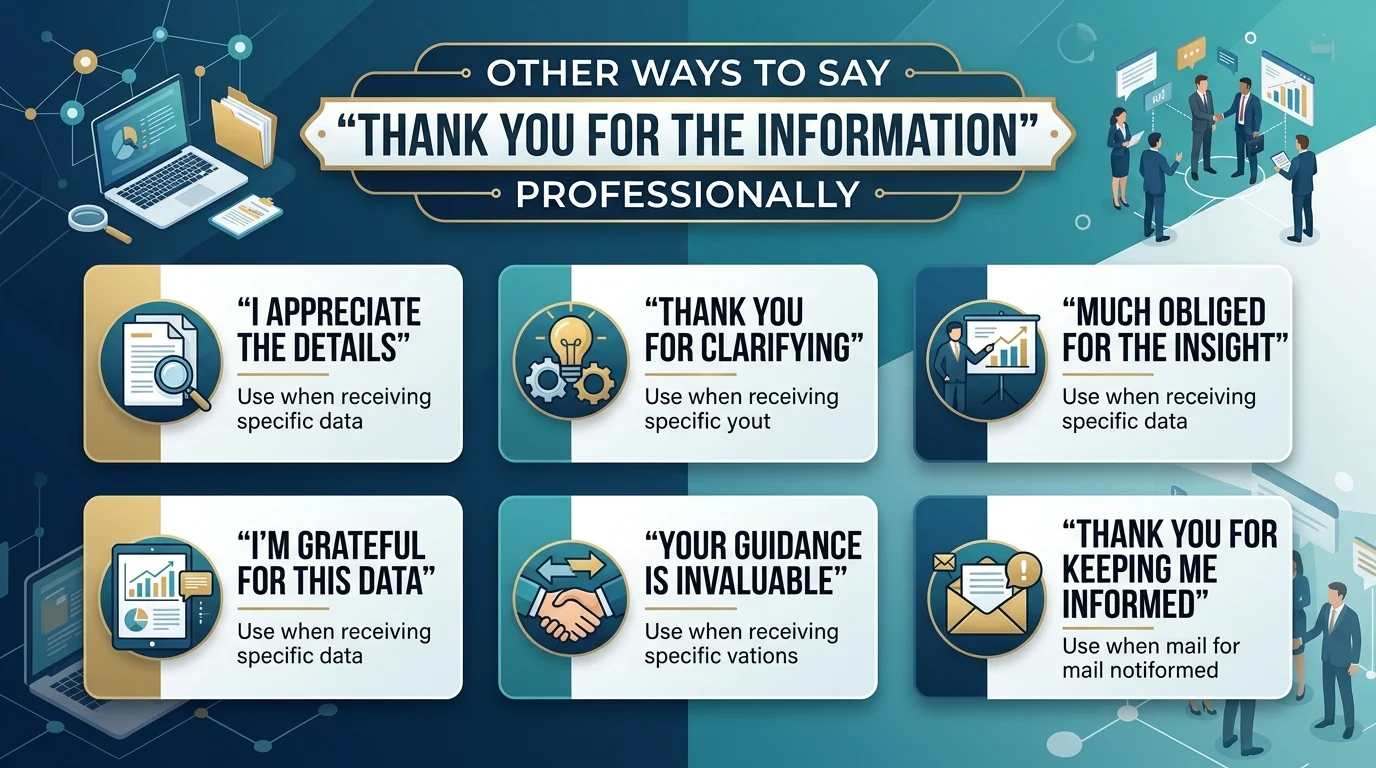
There are several professional alternatives you can use, including “Thank you for the update,” “I appreciate the information,” “Thank you for sharing these details,” “I appreciate you keeping me informed,” and “Thank you for bringing this to my attention.” Although these phrases express similar feelings of gratitude, each has a slightly different meaning and purpose. Some are best for acknowledging routine updates, while others are more suitable for recognizing helpful advice, important details, or information that requires your attention.
In this article, we will explore more than 20 other ways to say “thank you for the information” professionally, with clear explanations, appropriate usage tips, and practical example sentences. Whether you are replying to a business email, communicating with your manager, responding to a client, or acknowledging information from a colleague, these alternatives will help you express gratitude with confidence. By using the right phrase for each situation, you can improve your professional English, strengthen workplace relationships, and make your written communication sound more courteous and natural.
However, using the same expression in every email, meeting, or workplace conversation can sometimes sound repetitive. Depending on the situation, you may want to choose a phrase that sounds more formal, friendly, specific, or professional. For example, “I appreciate the update” works well when someone shares recent developments, while “Thank you for clarifying that” is more appropriate when someone explains a confusing issue.
Learning different ways to say “Thank you for the information” can help you communicate more naturally and confidently. It is especially useful for English learners who want to improve their workplace communication, write better emails, and develop a professional tone without sounding overly formal.
The best expression depends on several factors, including your relationship with the recipient, the type of information you received, and the purpose of your message. A short reply to a coworker may require only a few words, while an email to a client or senior manager may benefit from a more polished expression.
In this guide, you will discover more than 30 professional alternatives to “Thank you for the information,” along with their meanings, appropriate uses, tone descriptions, and practical examples. You will also learn how to use these expressions in formal emails, casual conversations, business meetings, and everyday workplace communication.
By choosing the right phrase for each situation, you can express appreciation clearly, avoid repetitive language, and maintain positive professional relationships.
Why Use Alternatives to “Thank You for the Information”?
Although “Thank you for the information” is correct and widely understood, different situations call for different expressions. Choosing an appropriate alternative can make your communication more specific and natural.
Here are some important reasons to use different phrases.
1. To Sound More Professional
Professional communication often benefits from clear and purposeful language. Expressions such as “I appreciate the details you provided” or “Thank you for the clarification” can sound more specific than a general thank-you.
For example:
“Thank you for the information regarding the upcoming project.”
You could write:
“I appreciate the details you provided regarding the upcoming project.”
Both sentences are professional, but the second emphasizes appreciation for the effort involved in sharing the details.
2. To Avoid Repetition
If you frequently respond to emails, messages, and reports, you may find yourself using the same phrase repeatedly. Having several alternatives helps keep your communication varied without making it complicated.
For example, you might use “Thanks for the update” for a project status report and “I appreciate your explanation” when a coworker helps you understand a process.
3. To Show Specific Appreciation
Sometimes, the information you receive saves time, resolves a problem, or helps you make an important decision. A more specific expression communicates that value.
For example:
“Thank you for sharing these figures. They will help us finalize the budget.”
This response acknowledges the information and explains how you will use it.
4. To Match the Situation
A message to a client may require a different tone from a message to a close coworker. Formal expressions are useful for external business communication, while shorter and friendlier expressions often work well in team chats.
Selecting an appropriate phrase helps you sound respectful without being unnecessarily stiff.
Common Alternatives to “Thank You for the Information”
The following expressions work in many professional situations. They are useful starting points for emails, meetings, and workplace conversations.
1. I Appreciate the Information
Meaning: This phrase expresses genuine gratitude for the information someone has shared.
When to use it: Use it when responding to a colleague, supervisor, client, or business partner. It is especially useful when you want a professional tone that still feels natural.
Tone: Professional, polite, and friendly.
Examples:
- “I appreciate the information you shared about the revised project timeline.”
- “I appreciate the information. I will review the details and get back to you.”
This is one of the most versatile alternatives because it works in both formal emails and everyday workplace conversations.
2. Thanks for the Update
Meaning: This expression thanks someone for providing new information about an ongoing situation.
When to use it: Use it when someone shares progress on a project, changes to a schedule, a meeting update, or news about a business decision.
Tone: Professional, casual, and friendly.
Examples:
- “Thanks for the update on the client meeting.”
- “Thanks for the update. I will adjust the schedule accordingly.”
This phrase is more specific than “Thank you for the information” because it focuses on new developments rather than information in general.
3. Thank You for Sharing These Details
Meaning: This phrase acknowledges the effort someone made to provide useful or specific information.
When to use it: Use it when receiving reports, instructions, project requirements, or detailed explanations.
Tone: Professional, polite, and appreciative.
Examples:
- “Thank you for sharing these details about the upcoming presentation.”
- “Thank you for sharing the details. They will help us prepare for the meeting.”
Choose this expression when the information includes several important points rather than a simple update.
4. I Appreciate Your Input
Meaning: This phrase expresses appreciation for someone’s thoughts, suggestions, knowledge, or contribution.
When to use it: Use it when a colleague offers feedback, participates in a discussion, or shares expertise that helps you evaluate a situation.
Tone: Professional, respectful, and collaborative.
Examples:
- “I appreciate your input on the proposed marketing strategy.”
- “I appreciate your input. Your suggestions will help us improve the plan.”
Although it can acknowledge information, this phrase is best when the other person has contributed ideas or judgment, not merely passed along facts.
5. Thanks for Letting Me Know
Meaning: This expression thanks someone for informing you about something.
When to use it: Use it when someone tells you about a schedule change, an issue, a decision, or an important development.
Tone: Friendly, polite, and professional.
Examples:
- “Thanks for letting me know about the revised deadline.”
- “Thanks for letting me know. I will update the team.”
It is particularly natural in email replies and workplace messaging.
6. Thank You for the Clarification
Meaning: This phrase expresses gratitude when someone explains something that was unclear or corrects a misunderstanding.
When to use it: Use it after receiving an explanation of instructions, requirements, expectations, or a confusing point in a discussion.
Tone: Professional, polite, and formal.
Examples:
- “Thank you for the clarification regarding the payment terms.”
- “Thank you for the clarification. I now understand the next steps.”
Use this phrase when the information makes something clearer. It is not the best choice when someone is simply sharing general news.
7. I Appreciate You Keeping Me Informed
Meaning: This expression thanks someone for providing regular updates.
When to use it: Use it when a colleague, manager, or client keeps you informed about an ongoing project, decision, or situation.
Tone: Professional, appreciative, and respectful.
Examples:
- “I appreciate you keeping me informed about the project’s progress.”
- “Thank you for the regular updates. I appreciate you keeping me informed.”
This expression is especially useful when communication over time is important.
8. Thank You for Bringing This to My Attention
Meaning: This phrase thanks someone for pointing out an issue, concern, opportunity, or important detail.
When to use it: Use it when someone identifies a mistake, highlights a risk, reports a problem, or brings something to your notice that you might otherwise have missed.
Tone: Professional, formal, and polite.
Examples:
- “Thank you for bringing the scheduling conflict to my attention.”
- “Thank you for bringing this issue to my attention. I will look into it.”
This phrase is particularly appropriate for workplace problem-solving. It does not simply acknowledge information; it recognizes that the information deserved attention.
Formal Alternatives for Business Communication
When communicating with senior managers, clients, external partners, or people you do not know well, a more formal expression may be appropriate.
9. Thank You for Providing This Information
Meaning: This phrase formally acknowledges that someone has supplied information.
When to use it: Use it in business emails, official correspondence, administrative requests, and client communication.
Tone: Formal, professional, and polite.
Examples:
- “Thank you for providing this information regarding the contract.”
- “Thank you for providing the requested information. We will review it shortly.”
It is a safe option when you want to remain courteous and neutral.
10. I Am Grateful for the Information You Have Shared
Meaning: This expression communicates sincere appreciation for the information received.
When to use it: Use it when someone has provided particularly useful information, offered meaningful assistance, or taken time to explain something important.
Tone: Formal, respectful, and appreciative.
Examples:
- “I am grateful for the information you have shared about the proposed changes.”
- “I am grateful for the guidance and information you provided during our discussion.”
This expression sounds warmer and more emphatic than a standard thank-you. For a routine email, a shorter alternative may sound more natural.
11. Thank You for Your Detailed Explanation
Meaning: This phrase thanks someone for explaining a subject carefully and thoroughly.
When to use it: Use it when a person explains a complex process, policy, technical issue, or business decision.
Tone: Formal, professional, and appreciative.
Examples:
- “Thank you for your detailed explanation of the new reporting procedure.”
- “Thank you for your detailed explanation. It helped me understand the requirements.”
This is a good choice when the person has done more than simply send information.
12. I Appreciate the Details You Provided
Meaning: This phrase acknowledges the usefulness and relevance of the details someone shared.
When to use it: Use it after receiving documentation, specifications, instructions, or information needed for a decision.
Tone: Professional, formal, and polite.
Examples:
- “I appreciate the details you provided regarding the proposal.”
- “I appreciate the details you provided and will incorporate them into the report.”
It is a polished expression that works well in formal email exchanges.
13. Thank You for Your Prompt Response
Meaning: This phrase thanks someone for replying quickly.
When to use it: Use it when the speed of the response matters, especially in business correspondence or time-sensitive discussions.
Tone: Formal, professional, and courteous.
Examples:
- “Thank you for your prompt response and for providing the requested figures.”
- “Thank you for your prompt response. This information will help us move forward.”
This phrase is best when the person responded quickly. If speed is not relevant, “Thank you for the information” may be more accurate.
14. Thank You for Supplying the Requested Information
Meaning: This expression formally acknowledges that someone has provided information you requested.
When to use it: Use it for administrative communication, formal business correspondence, customer service, or document-related requests.
Tone: Formal, professional, and neutral.
Examples:
- “Thank you for supplying the requested information about the application.”
- “Thank you for supplying the requested information. We will contact you if anything else is needed.”
Although correct, “supplying” can sound more administrative than conversational. In a friendly email, “providing” may feel more natural.
15. Your Explanation Is Much Appreciated
Meaning: This phrase communicates that you value the time and effort someone spent explaining something.
When to use it: Use it when a colleague or professional contact has helped you understand a process or decision.
Tone: Formal, professional, and appreciative.
Examples:
- “Your explanation of the revised procedure is much appreciated.”
- “Your explanation is much appreciated, and I will follow the recommended steps.”
This expression is polite, but it can sound slightly impersonal. Use “I appreciate your explanation” when you prefer a more direct and personal tone.
Professional Alternatives for Workplace Emails
The following expressions are particularly useful when communicating with coworkers, supervisors, clients, and project teams.
16. This Is Very Helpful, Thank You
Meaning: This phrase acknowledges that the information is useful and expresses appreciation.
When to use it: Use it when someone sends instructions, shares data, answers a question, or provides information that helps you complete a task.
Tone: Professional, friendly, and appreciative.
Examples:
- “This is very helpful, thank you. I will use these figures in the report.”
- “This is very helpful, thank you for explaining the process.”
It is effective because it tells the recipient why their contribution matters.
17. Thank You for the Valuable Insight
Meaning: This phrase thanks someone for sharing an observation, interpretation, or perspective that provides a better understanding of a subject.
When to use it: Use it after receiving thoughtful analysis, expert advice, or a useful observation during a meeting or discussion.
Tone: Professional, respectful, and appreciative.
Examples:
- “Thank you for the valuable insight into our customers’ needs.”
- “Thank you for sharing your valuable insight during today’s meeting.”
An insight is more than a basic fact. Choose this phrase when the person has offered a meaningful perspective.
18. I Appreciate the Additional Context
Meaning: This expression thanks someone for explaining the background or circumstances surrounding an issue.
When to use it: Use it when someone provides background details that help you understand a decision, request, problem, or project.
Tone: Professional, analytical, and polite.
Examples:
- “I appreciate the additional context regarding the budget changes.”
- “Thank you for the additional context. It helps me understand the reasoning behind the decision.”
This phrase is particularly useful in project management, business analysis, and collaborative discussions.
19. Thank You for the Background Information
Meaning: This phrase acknowledges information that explains the history or circumstances of a situation.
When to use it: Use it when someone introduces a new project, explains a previous decision, or gives you the context needed to understand a task.
Tone: Professional, polite, and neutral.
Examples:
- “Thank you for the background information on the client account.”
- “Thank you for providing the background information. I now have a clearer understanding of the situation.”
Use it when the information helps explain how a situation developed.
20. I Will Take This Information Into Account
Meaning: This expression indicates that you will consider the information when making a decision or taking action.
When to use it: Use it when someone shares feedback, recommendations, concerns, or details that may influence your next steps.
Tone: Professional, respectful, and measured.
Examples:
- “Thank you for sharing your concerns. I will take this information into account.”
- “I appreciate the feedback and will take it into account when finalizing the proposal.”
This phrase acknowledges the information without promising to follow every recommendation. It is useful when you need time to evaluate what you have received.
FAQS
1. What is the most professional way to say “Thank you for the information”?
“I appreciate the information you provided” is an excellent general choice. It is clear, polite, and appropriate for most professional emails. For formal correspondence, “Thank you for providing this information” is also a reliable option.
2. How can I thank someone for information in an email?
Start with a direct expression of appreciation, such as “Thank you for sharing the details.” If appropriate, add a sentence explaining how you will use the information.
For example: “Thank you for sharing the details. I will review them and include the relevant points in the report.”
3. Is “Thanks for the update” professional?
Yes. “Thanks for the update” is widely suitable for professional communication, especially when responding to news about a project, schedule, decision, or ongoing task. For a more formal tone, you can write “Thank you for the update.”
4. What is a polite way to thank someone for explaining something?
You can say, “Thank you for the clarification,” “I appreciate your explanation,” or “Thank you for taking the time to explain.” Choose the first when something was unclear, the second for a general explanation, and the third when you want to recognize the person’s effort.
5. How do I thank a client for providing information?
Use a respectful and direct expression, such as “Thank you for providing the requested information.” You can also add a sentence about what happens next, such as “We will review the details and contact you if we need anything further.”
6. Can I say “I appreciate the information” to my boss?
Yes. It is polite and professional, and it works well when your boss shares an update, explains a decision, or provides useful details. If your boss has offered advice, “I appreciate your guidance” may be more appropriate.
7. How can I thank someone without sounding repetitive?
Choose expressions based on the kind of help you received. Use “Thanks for the update” for new developments, “Thank you for the clarification” for explanations, and “I appreciate your input” for feedback. You can also mention the specific value of the information instead of repeating the same thank-you phrase.
Conclusion
Knowing different ways to say “Thank You for the Information” professionally can make your emails, workplace conversations, and business messages more natural and effective. Although the original phrase is perfectly acceptable, choosing a more specific alternative can help you express appreciation in a way that better fits the situation.
For general professional communication, “I appreciate the information” and “Thank you for providing this information” are reliable choices. When someone shares new developments, “Thanks for the update” is concise and natural. If someone explains a confusing issue, “Thank you for the clarification” is more precise. When you want to acknowledge feedback, “I appreciate your input” communicates respect for the other person’s contribution.
For formal emails, choose expressions that are clear, respectful, and appropriate for the recipient. With familiar coworkers, shorter phrases such as “Good to know, thanks” or “Thanks for the heads-up” may sound more natural.
The most important thing is to match your words to the information you received. A good professional thank-you should feel genuine, communicate the right level of appreciation, and help the conversation move forward. By practicing these alternatives, you can build a more varied vocabulary and communicate with greater confidence in almost any professional setting.