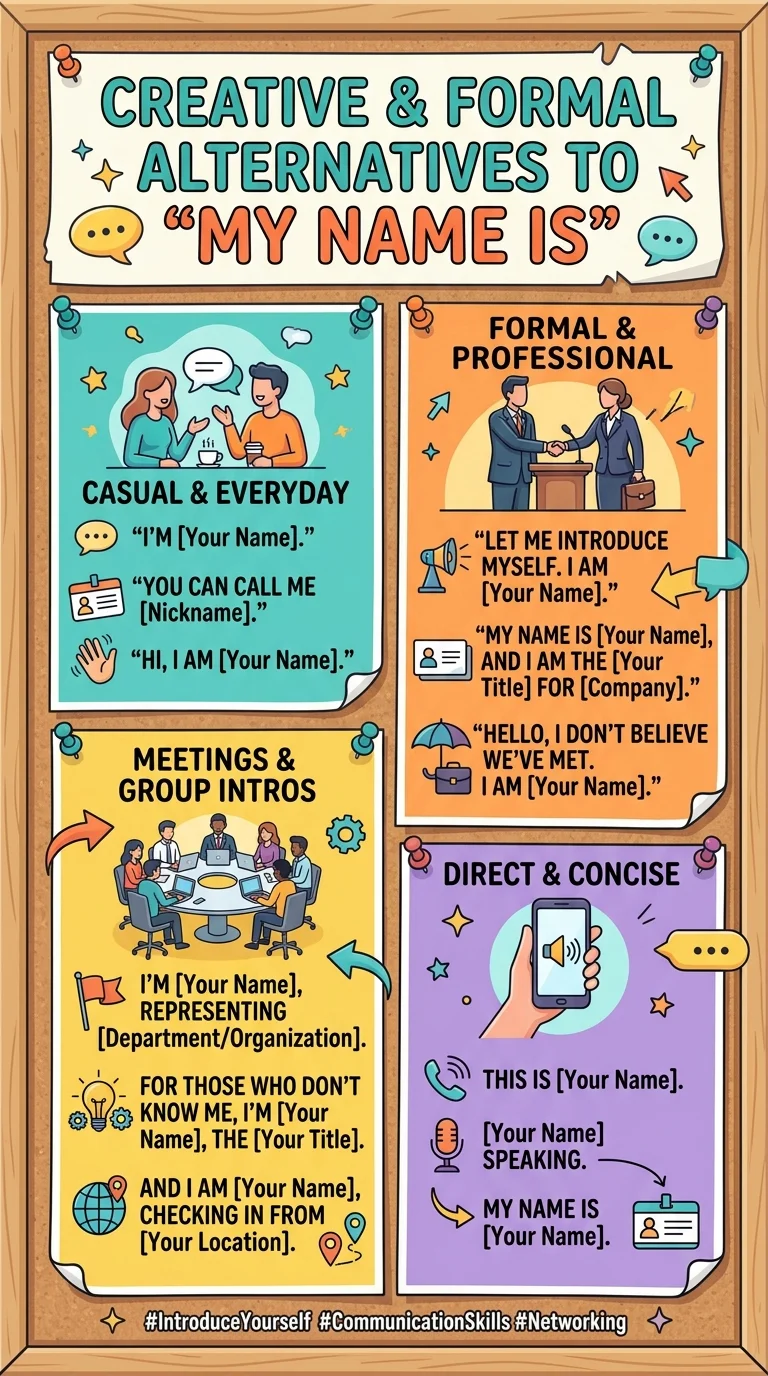
When you meet someone for the first time, one of the easiest ways to introduce yourself is to say, “My name is…” It is clear, correct, and works in almost any situation.
However, English speakers do not always use the same expression. Depending on the situation, you might say “I’m…,” “I go by…,” “You can call me…,” or “Let me introduce myself.” Each expression has a slightly different tone and purpose.
Learning these alternatives can help your English sound more natural and flexible. It can also help you choose the right expression for a job interview, classroom introduction, business meeting, party, phone call, email, or casual conversation.
For English learners, there is one important point to remember: you do not need a complicated expression to sound natural. In everyday American English, “I’m [name]” is often more common than the traditional “My name is [name].”
This guide explains more than 20 natural alternatives, including formal, professional, casual, friendly, polite, and texting expressions. It also explains when each one works best and gives practical examples.
Quick Guide: Alternatives to “My Name Is”
Here are some of the most useful alternatives at a glance:
| Expression | Tone | Common Use |
| I’m [name]. | Natural, casual, neutral | Everyday introductions |
| I am [name]. | Neutral, slightly formal | Introductions and writing |
| I’m called [name]. | Neutral | General conversation |
| I go by [name]. | Casual, natural | Preferred name or nickname |
| You can call me [name]. | Friendly, casual | Informal introductions |
| Please call me [name]. | Polite | Professional or personal |
| People call me [name]. | Casual | Nicknames and familiar names |
| Everyone calls me [name]. | Friendly, casual | Social conversations |
| My friends call me [name]. | Casual, personal | Talking about nicknames |
| The name’s [name]. | Very casual | Informal introductions |
| Name’s [name]. | Very casual | Short spoken introduction |
| I’m known as [name]. | Neutral/formal | Describing how you are known |
| I’m known by [name]. | Formal/neutral | Less common personal introduction |
| You may call me [name]. | Polite/formal | Formal settings |
| Allow me to introduce myself. I’m [name]. | Formal | Meetings and events |
| Let me introduce myself. I’m [name]. | Neutral/formal | Groups and meetings |
| I’d like to introduce myself. I’m [name]. | Polite/formal | Professional settings |
| For those who don’t know me, I’m [name]. | Friendly/neutral | Groups and presentations |
| I’m [name], by the way. | Casual | Joining an ongoing conversation |
| It’s [name]. | Casual | Phone calls and brief introductions |
| This is [name]. | Neutral | Phone calls or introducing yourself |
| You might know me as [name]. | Context-dependent | Online/public identity |
| I use the name [name]. | Neutral | Explaining a preferred or professional name |
| My full name is [name]. | Neutral/formal | Clarifying your complete name |
| My first name is [name]. | Neutral | Explaining part of your name |
The most important expressions to master are “I’m…,” “I go by…,” “You can call me…,” and “Let me introduce myself. I’m…” These cover a large range of everyday situations.
Common Alternatives to “My Name Is”
1. “I’m [Name].”
This is probably the most useful everyday alternative to “My name is…”
“I’m” is the contraction of “I am.” Native English speakers frequently use it when introducing themselves.
Meaning
It simply tells another person your name.
When to use it
Use it in almost any ordinary social situation:
- Meeting someone for the first time
- Joining a class
- Attending a party
- Meeting a colleague
- Introducing yourself to a customer
- Starting a conversation
Tone
Neutral, natural, casual, and friendly.
Examples
“Hi, I’m Daniel. Nice to meet you.”
“I’m Sarah. I work with James.”
For most everyday situations, this is one of the safest choices.
2. “I Am [Name].”
This means exactly the same thing as “I’m [Name]”, but the full form sounds slightly more deliberate.
When to use it
You can use it in speech or writing when you want a more formal or serious tone.
Tone
Neutral to formal.
Examples
“Good morning. I am Robert Miller, the new project manager.”
“I am Jennifer Lee, and I’ll be leading today’s presentation.”
In normal conversation, “I’m” usually sounds more relaxed.
3. “I’m Called [Name].”
This expression means that people call you by a particular name.
When to use it
It is grammatically correct, but it is generally less common in American English than “I’m…” or “My name is…” It can still be useful when explaining what people call you.
Tone
Neutral and conversational.
Examples
“I’m called Mike, although my full name is Michael.”
“At work, I’m called Alex.”
For a simple introduction, “I’m Alex” usually sounds more natural.
4. “I Go by [Name].”
This is an especially useful expression for English learners.
“I go by…” means that this is the name you normally use, even if it is not your full or legal name.
When to use it
Use it when:
- You have a nickname.
- You prefer a shorter version of your name.
- You use a middle name.
- You have a professional or English name.
- You want people to use a particular name.
Tone
Casual, natural, and friendly.
Examples
“My full name is Christopher, but I go by Chris.”
“My name is Alexandra, but I go by Alex.”
This expression is particularly useful when you want to explain what you prefer to be called.
5. “You Can Call Me [Name].”
This phrase gives the listener permission to use a particular name.
When to use it
It is common when you want to make an introduction warmer or less formal.
Tone
Friendly and casual.
Examples
“My name is Jonathan, but you can call me Jon.”
“I’m Samantha. You can call me Sam.”
It can also be used when someone has difficulty pronouncing your full name.
“My name is Alejandro, but you can call me Alex.”
Formal and Professional Alternatives
6. “Please Call Me [Name].”
This is similar to “You can call me…”, but it sounds more polite and direct.
When to use it
Use it when telling someone which name you prefer, especially in a professional or respectful setting.
Tone
Polite, professional, and friendly.
Examples
“My name is Elizabeth Thompson, but please call me Liz.”
“My full name is Jonathan Smith. Please call me John.”
It is useful when meeting coworkers, clients, teachers, or other people with whom you want to establish a preferred form of address.
7. “Let Me Introduce Myself. I’m [Name].”
This is a natural way to introduce yourself when you are speaking to a group or entering a new situation.
When to use it
Use it at:
- Meetings
- Classes
- Workshops
- Networking events
- Group discussions
- Presentations
Tone
Polite, professional, and neutral.
Examples
“Let me introduce myself. I’m David, and I’ll be working with your team.”
“Let me introduce myself. I’m Maria, the new marketing coordinator.”
This phrase focuses on the act of introducing yourself, rather than simply stating your name.
8. “Allow Me to Introduce Myself. I’m [Name].”
This is a more formal version of “Let me introduce myself.”
When to use it
It works in formal speeches, ceremonies, professional meetings, or situations where you want to sound particularly respectful.
Tone
Formal and polite.
Examples
“Allow me to introduce myself. I’m Dr. James Wilson.”
“Allow me to introduce myself. I’m Karen Lee, the director of the program.”
In everyday conversation, however, this may sound overly formal. Most people would simply say, “Hi, I’m Karen.”
9. “I’d Like to Introduce Myself. I’m [Name].”
This expression is polite without being as formal as “Allow me to introduce myself.”
When to use it
It is useful when addressing a group, particularly in professional settings.
Tone
Polite, professional, and moderately formal.
Examples
“I’d like to introduce myself. I’m Brian, and I recently joined the sales team.”
“I’d like to introduce myself. I’m Nina Patel, the new instructor.”
10. “For Those Who Don’t Know Me, I’m [Name].”
This expression is useful when speaking to a group that contains both familiar and unfamiliar people.
When to use it
You might use it:
- At a meeting
- During a presentation
- In a community group
- At a school event
- At a social gathering
Tone
Friendly, neutral, and professional depending on context.
Examples
“For those who don’t know me, I’m Kevin, the head of the design team.”
“For those who don’t know me, I’m Lisa. I’ve been teaching here for five years.”
This expression is especially useful because it acknowledges that some people may already know you.
Casual and Friendly Alternatives
11. “The Name’s [Name].”
This is a short, casual way to introduce yourself.
When to use it
It works best in informal conversations. You may hear it in movies, television, or playful introductions.
Tone
Very casual and sometimes humorous.
Examples
“The name’s Jack. Nice to meet you.”
“The name’s Emma. I’m the person you spoke to on the phone.”
It can sound a little dramatic if used in an ordinary situation, so beginners should generally prefer “I’m Jack.”
12. “Name’s [Name].”
This is an even shorter version of “The name’s…”
The subject and verb are omitted, which makes it sound informal.
Tone
Very casual.
Examples
“Name’s Tom. What’s yours?”
“Name’s Rachel. Nice to meet you.”
This is common in relaxed spoken English but should generally be avoided in formal writing.
13. “People Call Me [Name].”
This expression emphasizes what other people call you.
When to use it
Use it when discussing a nickname, familiar name, or name that is commonly used by others.
Tone
Casual and conversational.
Examples
“My name is William, but people call me Will.”
“My full name is Patricia, but people call me Pat.”
You normally would not use this as your only introduction unless the name people use is important to the conversation.
14. “Everyone Calls Me [Name].”
This is similar to “People call me…”, but it suggests that almost everyone in your social or professional circle uses that name.
Tone
Friendly and casual.
Examples
“My name is Benjamin, but everyone calls me Ben.”
“My full name is Katherine, although everyone calls me Kate.”
It is particularly natural when explaining a nickname.
15. “My Friends Call Me [Name].”
This expression specifically refers to the name used by your friends.
Tone
Casual, personal, and friendly.
Examples
“My name is Nicholas, but my friends call me Nick.”
“My full name is Rebecca, but my friends call me Becky.”
It is useful when distinguishing between your formal name and a nickname.
Alternatives for Texting and Everyday Conversation
16. “I’m [Name], by the Way.”
This is useful when you have already started talking and realize that you have not introduced yourself yet.
When to use it
Imagine you are chatting with someone at a coffee shop. After several minutes, you realize you never exchanged names.
You could say:
“Oh, I’m Mark, by the way.”
Tone
Casual and friendly.
Examples
“I’m Olivia, by the way. What’s your name?”
“Oh, I’m Daniel, by the way. I don’t think we’ve met before.”
This expression sounds natural because it does not make the introduction feel overly formal.
17. “It’s [Name].”
This is particularly common during phone calls or very brief conversations.
When to use it
Use it when someone asks who is calling or who is speaking.
Tone
Casual and neutral.
Examples
“Hi, who’s speaking?”
“It’s Mike.”
Or:
“Hey, it’s Jessica. Are you free to talk?”
The phrase works particularly well when the other person already knows you or is likely to recognize your name.
18. “This Is [Name].”
“This is…” is common when introducing yourself on the phone.
When to use it
It is especially natural when you are speaking to someone by phone.
Tone
Neutral, polite, and professional.
Examples
“Hello, this is Mr. Johnson. I’m calling about my appointment.”
“Hi, this is Anna. Is David available?”
You can also hear it in professional voicemail messages.
“Hello, this is Mark Davis from ABC Consulting.”
19. “You Know Me as [Name].”
This expression is used when explaining the name or identity by which someone knows you.
When to use it
It is useful when your name differs across different situations.
For example, you might have a professional name, online name, nickname, or stage name.
Tone
Neutral and context-dependent.
Examples
“My full name is Jonathan, but you know me as Jon.”
“You may know me as Alex online, although my full name is Alexander.”
It is less common as a basic first introduction.
20. “You May Know Me as [Name].”
This is a slightly more formal version of “You know me as…”
When to use it
It works well when you are explaining how people recognize you.
Tone
Polite, neutral, and somewhat formal.
Examples
“You may know me as Dr. Patel, but my first name is Anita.”
“You may know me as Alex from the support team.”
Frequently Asked Questions
1. What is the most natural way to say “My Name Is”?
For everyday American English, “I’m [name]” is one of the most natural choices.
For example:
“Hi, I’m Alex.”
It is short, friendly, and appropriate in many situations.
2. Is “I’m [name]” formal or informal?
It can be either. The phrase itself is neutral. The surrounding words and situation determine the level of formality.
For example:
“Hi, I’m Sarah.”
is casual and friendly.
But:
“Good morning. I’m Sarah Williams, the director of operations.”
is professional.
3. Is “I go by” the same as “My name is”?
Not exactly.
“My name is…” simply states your name.
“I go by…” tells people what name you normally use.
For example:
“My name is Christopher, but I go by Chris.”
This means Christopher is the person’s full name, while Chris is the name they normally use.
4. Can I say “Myself John” when introducing myself?
In standard American English, no. Say:
“I’m John.”
or:
“My name is John.”
“Myself” is normally used differently in English, so it should not replace “I” in a basic introduction.
5. Is “The name’s John” correct?
Yes, it is grammatically understandable and can sound natural in casual speech.
However, it is more informal than:
“My name is John.”
or:
“I’m John.”
For most learners, “I’m John” is the easiest and most natural choice.
6. What should I say when I want people to use my nickname?
Use:
“I go by [nickname].”
or:
“You can call me [nickname].”
For example:
“My name is Samantha, but I go by Sam.”
Both expressions are natural.
7. What is the best expression for a job interview?
There is no single required phrase. A simple, professional introduction works well:
“Good morning. I’m Daniel Smith. It’s nice to meet you.”
You can then briefly explain your professional background.
The key is to keep the introduction clear and appropriate to the situation.
Conclusion
“My name is…” is a perfectly correct and useful expression, but it is only one way to introduce yourself in English.
For everyday conversations, “I’m [name]” is one of the easiest and most natural choices. When you want to explain a nickname or preferred name, “I go by [name]” and “You can call me [name]” are especially useful.
For professional settings, expressions such as “This is [name],” “Let me introduce myself,” and “I’d like to introduce myself” can help you sound organized and polite.









