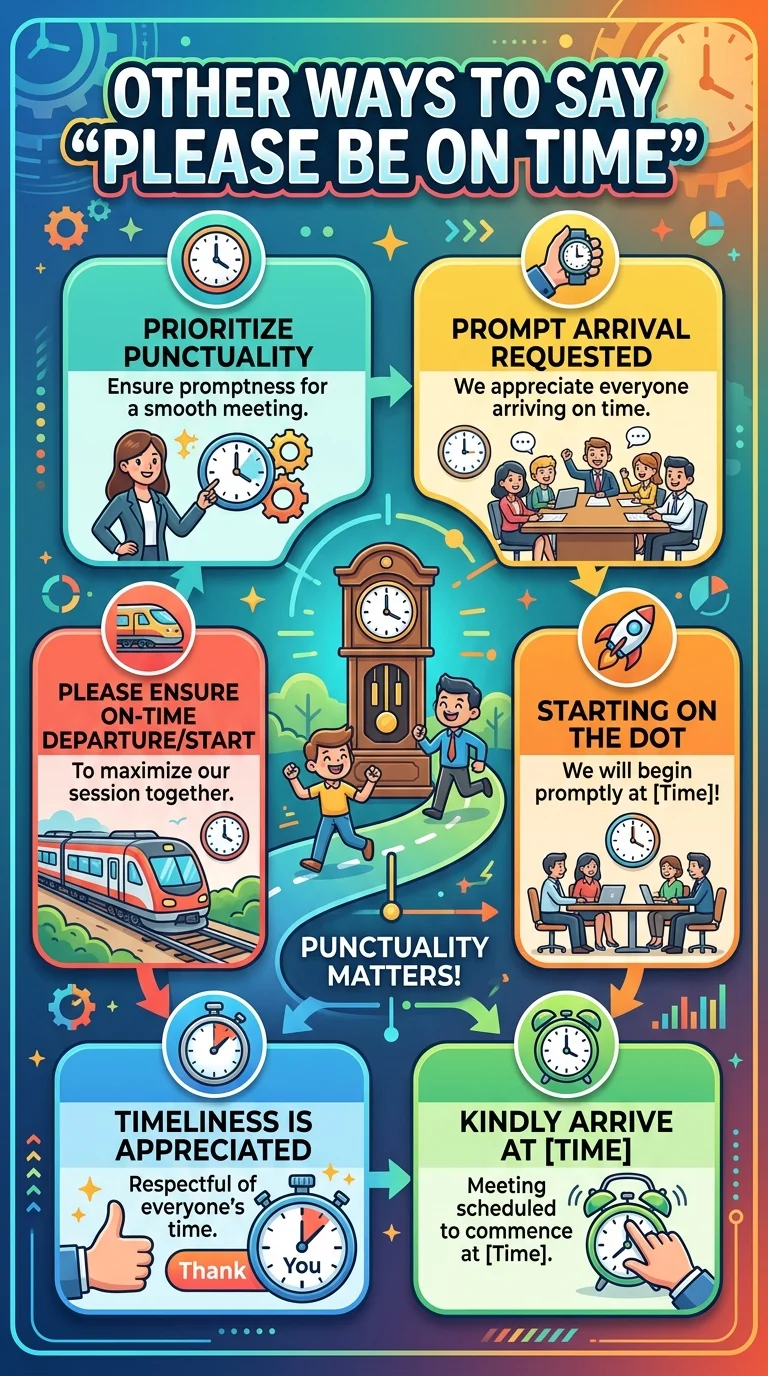
Being on time is important in many everyday situations. You might need to remind a friend about dinner, ask a student to arrive before class, or tell a coworker not to be late for a meeting. In each situation, “Please be on time” works well, but it can sometimes sound repetitive.
Using different expressions can help you match your words to the situation. A message to a close friend can sound relaxed, while a request to a coworker, employee, student, or customer may need a more professional tone.
There are also small differences between expressions. “Please arrive on time” is clear and polite, while “Please be punctual” sounds more formal. “Don’t be late” is common in everyday speech but can sound more direct.
This guide explains more than 20 natural ways to ask someone to arrive on time. Each expression includes its meaning, tone, appropriate situations, and examples.
Common Alternatives to “Please Be On Time”
Here are some of the most useful alternatives for everyday communication.
| Alternative | Tone | Best Used For |
| Please arrive on time. | Polite, neutral | General situations |
| Please be punctual. | Formal | Work, school, official settings |
| Please arrive promptly. | Formal | Meetings and appointments |
| Please make sure you’re on time. | Polite, direct | Work, school, plans |
| Please arrive as scheduled. | Professional | Events and appointments |
| Please don’t be late. | Direct, casual | Friends, family, everyday plans |
| Try to be on time. | Friendly | Casual reminders |
| Make sure you’re there on time. | Direct | Everyday situations |
| I’d appreciate it if you arrived on time. | Polite, professional | Work and formal requests |
| It’s important that you arrive on time. | Formal, serious | Important events |
| Please arrive a few minutes early. | Polite | Meetings and appointments |
| We’ll need you there on time. | Professional | Work and organized events |
| Please plan to arrive on time. | Polite | Events and schedules |
| Kindly arrive on time. | Formal | Written communication |
| Please be punctual for the meeting. | Formal | Workplace |
| Let’s make sure we’re on time. | Friendly, cooperative | Groups and friends |
| Don’t forget to be on time. | Friendly | Reminders |
| See you on time! | Casual, friendly | Texting |
| Make sure you’re not late. | Casual, direct | Friends and family |
| I’ll see you at the scheduled time. | Neutral | Professional or personal |
| Please be there by [time]. | Clear, direct | Appointments and events |
| We’re expecting you on time. | Professional, firm | Work or formal events |
| Please arrive at the agreed time. | Professional | Appointments and meetings |
1. Please Arrive on Time
“Please arrive on time” is one of the closest alternatives to “please be on time.”
It clearly asks someone to reach a particular place at the expected time. It sounds polite without being overly formal.
Tone: Polite, neutral, professional
Best for: Meetings, classes, appointments, events, and everyday plans
Examples:
- Please arrive on time for your appointment.
- Please arrive on time so we can start the meeting as planned.
This phrase works in almost any situation where punctuality matters.
2. Please Be Punctual
“Please be punctual” means “please arrive at the expected time.”
The word punctual is more formal than “on time,” so this expression appears more often in workplaces, schools, official notices, and professional communication.
Tone: Formal, professional, polite
Best for: Work, school, interviews, meetings, and official instructions
Examples:
- Please be punctual for all scheduled meetings.
- Students are expected to be punctual for class.
You probably wouldn’t use this phrase with a close friend unless you were joking or intentionally sounding formal.
3. Please Arrive Promptly
“Please arrive promptly” asks someone to arrive without unnecessary delay.
It can sound more formal and firm than “please arrive on time.” It works particularly well when an appointment or event has a specific starting time.
Tone: Formal, professional
Best for: Meetings, appointments, interviews, business events
Examples:
- Please arrive promptly at 9:00 a.m.
- All participants should arrive promptly for the briefing.
“Promptly” can also emphasize that you want someone to arrive exactly when expected.
4. Please Make Sure You’re on Time
This expression is a polite but slightly stronger reminder.
It suggests that being on time is important and that the person should take responsibility for arriving when expected.
Tone: Polite, direct, professional
Best for: Work, school, appointments, family plans
Examples:
- Please make sure you’re on time for the interview.
- Please make sure you’re on time tomorrow morning.
This is especially useful when someone has been late before.
5. Please Arrive as Scheduled
“Please arrive as scheduled” has a professional tone. It refers to an agreed or previously announced schedule.
It works better in written communication than casual conversation.
Tone: Professional, formal
Best for: Appointments, business events, organized activities
Examples:
- Please arrive as scheduled for your appointment.
- All guests should arrive as scheduled.
This expression sounds organized and clear without directly accusing someone of being late.
6. Please Don’t Be Late
“Please don’t be late” is extremely common in everyday English.
Unlike some formal alternatives, it sounds natural when talking to friends, family members, classmates, or coworkers you know well.
Tone: Casual, direct, friendly
Best for: Everyday plans and informal reminders
Examples:
- Please don’t be late for dinner.
- Please don’t be late tomorrow. We have a lot to do.
It is slightly more direct than “please be on time,” but adding please keeps it polite.
7. Try to Be on Time
“Try to be on time” sounds softer because the word try makes the request less forceful.
It can be useful when you want to remind someone without sounding demanding.
Tone: Friendly, casual, gentle
Best for: Friends, family, classmates, informal plans
Examples:
- Try to be on time tomorrow.
- Try to be on time for the movie.
However, this expression can sometimes sound less serious. For an important interview, “Please arrive on time” is usually clearer.
8. Make Sure You’re There on Time
This is a natural spoken expression. It emphasizes being physically present at the required place at the right time.
Tone: Casual, direct, neutral
Best for: Everyday plans, appointments, school, work
Examples:
- Make sure you’re there on time for the appointment.
- Make sure you’re there on time. The bus leaves at 8:00.
It is particularly useful when arriving late could cause someone to miss something.
9. I’d Appreciate It If You Arrived on Time
This is a polite way to make a stronger request.
Instead of giving a direct command, you explain that arriving on time would be appreciated.
Tone: Polite, professional, respectful
Best for: Workplace communication and situations requiring tact
Examples:
- I’d appreciate it if you arrived on time for future meetings.
- I’d appreciate it if everyone arrived on time tomorrow.
This expression can be especially helpful when addressing a recurring problem without sounding unnecessarily harsh.
10. It’s Important That You Arrive on Time
This phrase clearly communicates that punctuality matters.
It is stronger than a simple reminder, so use it when the timing has a real consequence.
Tone: Serious, formal, professional
Best for: Interviews, appointments, important meetings, exams, events
Examples:
- It’s important that you arrive on time for your interview.
- It’s important that everyone arrives on time because the presentation starts at 10.
This wording focuses on the importance of punctuality rather than simply giving an order.
11. Please Arrive a Few Minutes Early
Sometimes you don’t just need someone to avoid being late. You want them to arrive early enough to prepare.
In that case, this expression is more useful than “please be on time.”
Tone: Polite, professional, friendly
Best for: Interviews, appointments, meetings, classes
Examples:
- Please arrive a few minutes early for your interview.
- Please arrive a few minutes early so we can get started promptly.
This gives the listener a little extra guidance about when to arrive.
12. We’ll Need You There on Time
This expression emphasizes that someone’s presence is important.
It is often used when other people are depending on that person.
Tone: Professional, direct, neutral
Best for: Work, group activities, events, meetings
Examples:
- We’ll need you there on time for the team meeting.
- We’ll need everyone there on time because the event starts at six.
It can sound more serious than simply saying, “Please be on time.”
13. Please Plan to Arrive on Time
This expression encourages someone to think ahead and organize their schedule.
It doesn’t sound as forceful as “Don’t be late.”
Tone: Polite, neutral, professional
Best for: Meetings, events, appointments, classes
Examples:
- Please plan to arrive on time for the workshop.
- Please plan to arrive on time so registration can begin smoothly.
This is useful when you want to encourage responsibility rather than simply issue an instruction.
14. Kindly Arrive on Time
“Kindly” can make a request sound formal and courteous.
You may see this expression in written notices, workplace messages, invitations, or official communication.
Tone: Formal, polite
Best for: Written notices and professional communication
Examples:
- Kindly arrive on time for the scheduled appointment.
- Kindly arrive on time to avoid delays.
In casual American conversation, however, “please” usually sounds more natural than “kindly.”
15. Please Be Punctual for the Meeting
This is a more specific version of “please be punctual.”
It tells the listener exactly where punctuality matters.
Tone: Formal, professional
Best for: Business meetings, classes, interviews, appointments
Examples:
- Please be punctual for the meeting.
- Please be punctual for tomorrow’s training session.
This phrase works well in workplace emails and formal instructions.
16. Let’s Make Sure We’re on Time
This expression is different because it includes the speaker.
Instead of telling someone else what to do, you make punctuality a shared goal.
Tone: Friendly, cooperative, casual
Best for: Friends, families, teams, group plans
Examples:
- Let’s make sure we’re on time for the movie.
- Let’s make sure we’re on time for dinner.
This is a good choice when you want to avoid sounding bossy.
17. Don’t Forget to Be on Time
This phrase works as a friendly reminder.
It doesn’t necessarily suggest that the person is usually late. You are simply reminding them about the agreed time.
Tone: Friendly, casual, polite
Best for: Friends, family, students, coworkers
Examples:
- Don’t forget to be on time for class.
- Don’t forget to be on time tomorrow morning!
It works especially well in text messages.
18. See You on Time!
“See you on time!” is short and friendly.
It assumes that the other person knows when and where you are meeting.
Tone: Casual, friendly
Best for: Texting and everyday conversation
Examples:
- The movie starts at 7. See you on time!
- We’re meeting at 6:30. See you on time!
For professional communication, choose a clearer expression.
19. Make Sure You’re Not Late
This expression focuses directly on avoiding lateness.
It is common in spoken English and informal messages.
Tone: Casual, direct
Best for: Friends, family, everyday plans
Examples:
- Make sure you’re not late for the flight.
- Make sure you’re not late tomorrow.
It can sound slightly stronger than “try to be on time.”
20. I’ll See You at the Scheduled Time
This expression doesn’t directly command someone to be punctual. Instead, it establishes the expected time.
Tone: Neutral, professional
Best for: Appointments, business meetings, formal arrangements
Examples:
- I’ll see you at the scheduled time.
- Thank you for confirming. I’ll see you at the scheduled time.
This can be useful when you want to remain polite and professional.
FAQs About Other Ways to Say “Please Be On Time”
What is the most polite way to say “Please be on time”?
“Please arrive on time” is a simple and polite choice. It works in personal, educational, and professional situations.
For a softer professional request, you can say:
I’d appreciate it if you could arrive on time.
What is a formal way to say “Please be on time”?
“Please be punctual” and “Please arrive promptly” are formal alternatives.
For example:
Please be punctual for all scheduled meetings.
These expressions work well in professional or official communication.
How do I politely tell someone not to be late?
You can say:
Please make sure you’re on time.
Another friendly option is:
Don’t forget to be on time.
For a more professional message, try:
I’d appreciate it if you could arrive on time.
What is a casual way to say “Please be on time”?
“Don’t be late!” is one of the most natural casual choices.
You can also say:
Try to be on time!
or:
Make sure you’re there on time!
Is “Please be punctual” rude?
No. “Please be punctual” is a polite expression, but it sounds formal.
It may feel unnatural in a casual conversation with friends. In those situations, “Please be on time” or “Don’t be late” usually sounds more natural.
What can I say instead of “Please be on time” in a text?
Short expressions work well in texts.
For example:
Don’t be late!
See you at 7. Be there on time!
Please be there by 7.
Try to be on time!
The best option depends on how close you are to the person.
What is the difference between “arrive early” and “arrive on time”?
Arrive on time means reaching the place at the expected time.
Arrive early means reaching the place before the expected time.
For an interview, for example, you might ask someone to arrive early so they have enough time to check in and prepare.
Conclusion
There are many natural ways to say “Please be on time,” and the best expression depends on your relationship with the listener and the situation.
For a general and polite request, “Please arrive on time” is an excellent choice. In formal situations, “Please be punctual” or “Please arrive promptly” may fit better. For friends and family, “Don’t be late” or “Try to be on time” sounds more natural.
If you need to sound especially polite, try “I’d appreciate it if you arrived on time.” When punctuality is important, “It’s important that you arrive on time” makes the message clearer. If you need someone to arrive before the scheduled start, use “Please arrive a few minutes early.”
The most useful approach is to match the expression to the situation. Think about whether you need to sound formal, friendly, professional, gentle, or direct. With these alternatives, you can remind someone about punctuality without using the same phrase every time.









