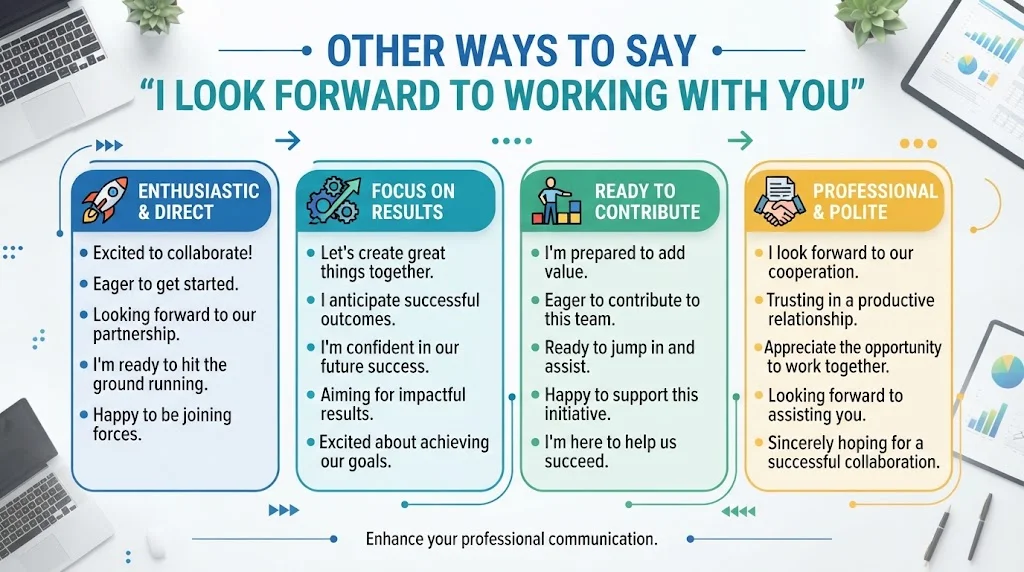
“I look forward to working with you” is one of the most useful phrases in professional English. You can use it after meeting a new colleague, accepting a job offer, starting a business relationship, joining a project, or replying to a professional email.
The phrase communicates a positive expectation about working together in the future. It sounds polite, professional, and friendly without being too personal.
However, using the same phrase repeatedly can make your emails and conversations sound predictable. English offers many natural alternatives, and each one can communicate a slightly different feeling. Some sound more formal, while others are warmer, more relaxed, or more suitable for everyday conversation.
For English learners, there is another important point: not every alternative is appropriate in every situation. A phrase that sounds natural in a message to a teammate might sound too casual in an email to a senior executive. Similarly, an expression that works well in a business email may feel unnecessarily formal when talking to a new coworker.
This guide explains more than 20 natural alternatives, including when to use each one, how formal it sounds, and examples you can adapt to your own situation.
What Does “I Look Forward to Working With You” Mean?
The phrase “I look forward to working with you” means that you are happy or excited about the opportunity to work together in the future.
For example:
“Thank you for accepting my proposal. I look forward to working with you.”
Here, the speaker is expressing a positive attitude toward the future professional relationship.
The phrase is especially common in:
- Business emails
- Job-related communication
- Introductions between colleagues
- Client communication
- Project discussions
- Networking
- Formal letters
- Professional messages
Is “I Look Forward to Working With You” Formal?
Yes. It is generally considered professional and polite, although it is not extremely formal.
You can use it with:
- A new employer
- A new employee
- A client
- A customer
- A business partner
- A coworker
- A manager
- A supplier
- A consultant
You can also make it slightly warmer by adding words such as “really,” “very much,” or “genuinely.”
For example:
“I really look forward to working with you.”
This sounds a little more enthusiastic while remaining professional.
Common Alternatives to “I Look Forward to Working With You”
Below are some of the most useful alternatives. They are organized by tone so you can quickly find the right expression.
1. “I’m Looking Forward to Working With You.”
This is probably the closest everyday alternative.
Meaning
It has essentially the same meaning as “I look forward to working with you,” but the “I’m looking forward” structure sounds slightly more conversational.
When to use it
Use it in:
- Emails
- Team messages
- Conversations
- Introductions
- Professional chats
Tone
Professional, friendly, natural
Examples
“Thanks for the introduction. I’m looking forward to working with you.”
“It was great meeting you today. I’m looking forward to working with you on the project.”
For many situations, this is the easiest alternative for English learners to use.
2. “I’m Excited to Work With You.”
This expression communicates more enthusiasm.
Meaning
You are saying that you are genuinely enthusiastic about the opportunity to work together.
When to use it
This works well when you want to sound energetic and positive, particularly at the beginning of a new project or relationship.
Tone
Professional, friendly, enthusiastic
Examples
“I’m excited to work with you and the rest of the team.”
“We’re excited to work with you on this new initiative.”
It is slightly more enthusiastic than “I look forward to working with you.”
3. “I’m Excited to Be Working With You.”
This version emphasizes that the working relationship is beginning or is already underway.
Meaning
It expresses enthusiasm about being part of the same team or project.
When to use it
Use it after joining a team, beginning a project, or starting a professional relationship.
Tone
Friendly, professional, positive
Examples
“Thank you for welcoming me to the team. I’m excited to be working with you.”
“We’re excited to be working with you on this project.”
4. “It Will Be a Pleasure to Work With You.”
This is more formal and polite.
Meaning
You are saying that you expect working together to be a positive experience.
When to use it
This expression is particularly useful in formal correspondence, especially with clients, business partners, or senior professionals.
Tone
Formal, polite, professional
Examples
“Thank you for choosing our company. It will be a pleasure to work with you.”
“We appreciate the opportunity, and it will be a pleasure to work with you.”
It sounds more formal than “I’m excited to work with you.”
5. “It’s a Pleasure to Work With You.”
Be careful with the tense here.
Meaning
“It’s a pleasure to work with you” normally suggests that you are already working together.
When to use it
Use this after the professional relationship has started.
Tone
Professional, polite, warm
Examples
“Thank you for your continued support. It’s a pleasure to work with you.”
“You’ve been very helpful throughout the project. It’s a pleasure to work with you.”
If you have not started working together yet, “It will be a pleasure to work with you” is usually more appropriate.
Formal Alternatives
When writing to a senior executive, important client, new business partner, or formal organization, you may want a more polished expression.
6. “I Welcome the Opportunity to Work With You.”
This is a useful formal alternative.
Meaning
You are expressing appreciation for the opportunity to establish a professional relationship.
When to use it
It works particularly well in:
- Business letters
- Formal emails
- Client communication
- Proposals
- Professional introductions
Tone
Formal, professional, polite
Examples
“I welcome the opportunity to work with you on this important project.”
“We welcome the opportunity to work with your organization.”
This sounds more formal than “I’m looking forward to working with you.”
7. “I’m Pleased to Have the Opportunity to Work With You.”
This expression combines professionalism with warmth.
Meaning
You are happy that you have been given the opportunity to work together.
When to use it
Use it in formal business correspondence or when beginning an important professional relationship.
Tone
Formal, professional, polite
Examples
“I’m pleased to have the opportunity to work with you on this project.”
“We’re pleased to have the opportunity to work with your team.”
8. “I Appreciate the Opportunity to Work With You.”
This version emphasizes gratitude.
Meaning
Instead of focusing mainly on your excitement about the future, you are thanking the other person for the opportunity.
When to use it
This is useful after:
- Receiving a contract
- Accepting an assignment
- Being selected for a project
- Beginning a partnership
- Starting a new role
Tone
Professional, polite, appreciative
Examples
“I appreciate the opportunity to work with you and your team.”
“Thank you for selecting us. We appreciate the opportunity to work with you.”
9. “I’m Honored to Have the Opportunity to Work With You.”
This is a much stronger expression of respect.
Meaning
You are saying that you consider the opportunity particularly meaningful or prestigious.
When to use it
Use it selectively. It can be appropriate when working with a highly respected professional, organization, or institution.
Tone
Very polite, formal, respectful
Examples
“I’m honored to have the opportunity to work with you.”
“We’re honored to partner with your organization on this initiative.”
Because “honored” is strong, it can sound excessive in an ordinary workplace situation.
Professional Alternatives
Professional English does not always need to sound formal. In many workplaces, natural and direct language is preferred.
10. “I’m Looking Forward to Collaborating With You.”
“Collaborating” emphasizes cooperation.
Meaning
You are looking forward to working together toward a shared goal.
When to use it
This works especially well for:
- Projects
- Creative work
- Research
- Marketing
- Technology
- Consulting
- Cross-functional teams
Tone
Professional, collaborative
Examples
“I’m looking forward to collaborating with you on the new campaign.”
“We’re looking forward to collaborating with your team.”
This is particularly useful when the work involves several people contributing ideas.
11. “I’m Excited About Working Together.”
This sounds natural and positive.
Meaning
You are enthusiastic about the future work you will do together.
When to use it
It is appropriate for professional emails, team communication, and business conversations.
Tone
Professional, friendly, enthusiastic
Examples
“Thanks for getting in touch. I’m excited about working together.”
“We’re excited about working together to bring this project to life.”
12. “I’m Looking Forward to Our Collaboration.”
This focuses on the relationship or project rather than the individuals.
Meaning
You are anticipating the future cooperation between you.
When to use it
This is useful in business writing, particularly when communicating with another company or team.
Tone
Professional, polished
Examples
“Thank you for the opportunity. I’m looking forward to our collaboration.”
“We’re looking forward to our collaboration and the opportunities ahead.”
13. “I’m Looking Forward to Getting Started.”
This is a very useful alternative when the work has not begun yet.
Meaning
You are eager to begin the project or task.
When to use it
Use it when the next step is starting work.
Tone
Professional, friendly, positive
Examples
“Everything is now in place, so I’m looking forward to getting started.”
“Thanks for sending the project details. I’m looking forward to getting started.”
It does not explicitly mention the other person, but the meaning is often clear from context.
14. “I’m Eager to Get Started.”
This is a little more enthusiastic.
Meaning
You are ready and enthusiastic about beginning.
When to use it
Use it in professional situations when you want to communicate energy and motivation.
Tone
Professional, enthusiastic
Examples
“I have reviewed the materials and I’m eager to get started.”
“We’re eager to get started and begin making progress.”
15. “I’m Looking Forward to Getting to Know You and the Team.”
This is useful when you are joining a new workplace.
Meaning
You are looking forward not only to the work but also to building relationships with your new colleagues.
When to use it
Especially useful for:
- New jobs
- New departments
- Team introductions
- Onboarding
Tone
Professional, warm, friendly
Examples
“Thank you for the warm welcome. I’m looking forward to getting to know you and the team.”
“I’m excited to join the company and look forward to getting to know everyone.”
Casual and Everyday Alternatives
When speaking with a coworker you already know or sending a relaxed message, you can use simpler language.
16. “I’m Excited to Work Together.”
This is short, natural, and flexible.
Meaning
You are happy about the opportunity to work together.
When to use it
It works well in:
- Team chats
- Messages
- Conversations
- Informal work emails
Tone
Casual, friendly, professional
Examples
“Great to have you on the project. I’m excited to work together.”
“Thanks for reaching out. I’m excited to work together.”
17. “Can’t Wait to Work With You.”
This is more enthusiastic and informal.
Meaning
You are very excited about working together.
When to use it
Use this with people you know reasonably well or in relaxed professional environments.
Tone
Informal, enthusiastic, friendly
Examples
“Thanks for joining the project. Can’t wait to work with you!”
“This is going to be a fun project. Can’t wait to work with you.”
Avoid this in highly formal correspondence because “can’t wait” can sound too casual.
18. “Looking Forward to It!”
This is one of the most natural short expressions in English.
Meaning
It means you are looking forward to the event, activity, or work already mentioned.
When to use it
Use it when the context already makes clear what “it” refers to.
Tone
Casual, friendly, natural
Examples
“See you at the meeting tomorrow!”
“Looking forward to it!”
Or:
“We’ll start the project Monday. Looking forward to it!”
Because the phrase is short, it works particularly well in messages and conversations.
19. “Looking Forward to Working Together!”
This is a very natural alternative that removes “I.”
Meaning
It communicates the same basic idea as the original phrase.
When to use it
Use it in professional emails, messages, and introductions.
Tone
Professional, friendly, concise
Examples
“Thanks for reaching out. Looking forward to working together!”
“It was great speaking with you. Looking forward to working together.”
This is especially common in email because it is concise without sounding cold.
Friendly Alternatives
Sometimes you want to emphasize the relationship rather than simply the work.
20. “It’ll Be Great Working With You.”
This is friendly and conversational.
Meaning
You expect the experience of working together to be positive.
When to use it
Use it with coworkers, teammates, clients you already know, or people in relaxed professional settings.
Tone
Friendly, casual, professional
Examples
“Thanks for joining the team. It’ll be great working with you.”
“I’m glad we’ll be on the same project. It’ll be great working with you.”
FAQ
1. Is “I look forward to working with you” professional?
Yes. It is a standard professional expression used in emails, business conversations, job-related communication, and introductions.
It is polite without being excessively formal.
2. What is the most natural alternative to “I look forward to working with you”?
“I’m looking forward to working with you” is probably the easiest alternative.
It has essentially the same meaning but often sounds slightly more conversational.
3. Can I say “I’m excited to work with you” in a business email?
Yes. It is perfectly appropriate in many modern business settings.
It sounds more enthusiastic than “I look forward to working with you,” so use it when you genuinely want to communicate excitement.
4. Is “Looking forward to working with you” grammatically correct?
Yes, especially in emails and messages.
It is a shortened form of:
“I’m looking forward to working with you.”
In a very formal letter, the complete version may sound more polished, but the shorter form is extremely common in professional communication.
5. Is “Can’t wait to work with you” professional?
It can be, but it is informal and enthusiastic.
It is more suitable for a friendly coworker, teammate, or relaxed professional environment than for a highly formal business letter.
6. What is the difference between “I look forward to working with you” and “I’m excited to work with you”?
Both express positive feelings about future work.
“I look forward to working with you” is more neutral and professional.
“I’m excited to work with you” communicates stronger enthusiasm.
For example, a formal client email might use the first, while a new-team introduction might naturally use the second.
7. Should I say “working with you” or “working together”?
Both are correct.
Use “working with you” when you want to address the person directly:
“I’m looking forward to working with you.”
Use “working together” when you want to emphasize joint effort:
“I’m looking forward to working together.”
The difference is small, so either can work in many situations.
Conclusion
“I look forward to working with you” is already a natural and useful phrase, but you do not have to use it every time. Choosing a different expression can help your English sound more varied and can allow you to communicate a more precise tone.
The key is to consider who you are speaking to, how formal the situation is, and how much enthusiasm you want to express. You do not need complicated vocabulary to sound professional. In many cases, the simplest expression—such as “I’m looking forward to working with you”—is also the most natural.
If you want, I can also turn these alternatives into a short cheat sheet with 50 ready-to-use email sentences for work, clients, interviews, and everyday conversation.









